

Soldier Record
Francis Brown
Contributed by: Harvey Leslie, on 2008-11-05
| Rank | |
|---|---|
| First Name | Francis |
| Surname | Brown |
| Year of Birth | 1893 |
| Year of Death | 1981 |
| Regiment | Royal Field Artillery |
| Place of Wartime Residence | Rugby, Warwickshire |
Francis's Story
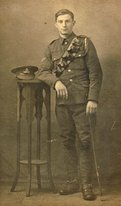
My father-in-law was Francis (Frank) Brown, Driver, Royal Field Artillery, army number 11040. He was born on 23 September 1893 at Belton in Rutland and went to Market Harborough Grammar School, riding a pony there each day from Stoke Albany. When he left school at 14 he became a butcher and also joined the Leicestershire Yeomanry. He moved to Rugby in 1911 and, when the First World War started in the autumn of 1914, he was one of the first men to enlist in the Army. He joined the Royal Field Artillery on 3rd September and was sent for training to Chapeltown Barracks, Leeds but managed to get some leave soon afterwards to marry, by special licence, his girlfriend Edith May Smith on 12th November 1914.
A simple soldier of the Great War - lucky to survive.
Having spent the first 10 months of the war training in England, Frank's unit arrived in Egypt on 17th July 1915 and spent a month training for their first operation. Between 6th and 9th August 1915 he landed at Suvla Bay on the Gallipoli peninsula to fight the Turkish Army. The idea was to capture and destroy some huge gun emplacements overlooking the Dardanelle Straights so that the British Navy could sail safely from the Mediterranean to the Black Sea and then support the Russians who were our allies and were fighting the Germans on the Eastern Front. However, the whole Gallipoli operation was a disaster. The Turkish Army were well dug in and the British, Australian and New Zealand (ANZAC) forces could not make any progress off the beaches. They suffered huge casualties both in fighting and from sickness. The British contingent alone took 265,000 casualties (of which 145,000 were from sickness). After a relatively short time the decision was taken to pull out and the final units left on 8th January 1916. They had achieved nothing.
Frank's unit returned to Egypt where it spent most of 1916 being reorganised and brought back up to strength. (One example is a Royal Field Artillery unit that went to Suvla Bay with 465 officers and men and returned to Egypt with 41.) In October 1916 his unit was then posted to Salonika to join the 84th Brigade of 28th Division that was part of the Allied armies (British, French and Greek) that was trying to stop the Bulgarians from invading Greece. He was fortunate in one respect that he became the batman to one of the officers in his unit, but he still was involved in the fighting. Wounded in the 1918 offensive, he was taken by ship to Egypt where he spent some time in hospital, then, while being shipped home, he got pneumonia and was disembarked at Naples where he spent a long time in an Italian hospital. Eventually he arrived back in England on 25th November 1918 and was discharged from the Army on 7th March 1919.
In 1921 he went to work in the Transport Department of British Thomson Houston Company in Rugby where he remained until his retirement in 1965. He had an enduring love of horses and, in his spare time, taught riding and went hunting until he was over 80.


No additional memories have been submitted