

Soldier Record
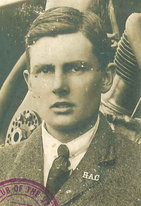
Edward Robert Pennell
Contributed by: Ninety Years of Remembrance, on 2008-11-01
| Rank | |
|---|---|
| First Name | Edward Robert |
| Surname | Pennell |
| Year of Birth | Unknown |
| Year of Death | Unknown |
| Regiment | Royal Flying Corps |
| Place of Wartime Residence | Clacton-on-Sea, Essex |
Edward Robert's Story
Captain Pennell served with No 27 and No 84 Squadrons, Royal Flying Corps and was involved with numerous raids into German territory. Here, his memoir relates an amusing story about the RFC's attempt to use pigeons as a means of communicating with spies.
A burst of 'Archie' came up at me, but it did not worry me unduly
"The hapless Pigeons were placed in a long iron box fixed under the fuselage between the undercarriage, and controlled by the joy stick (flying control column) to which was attached a Bowden wire. When the wire was pulled, it opened the bottom of the box thus ejecting the pigeons each separated in its own compartment in the box.
The individual pigeons wore a small harness to which was attached, by a piece of string, a small ring. The idea was that they would fly against each other and gradually drop to the ground. In practise it was found that after a few drops the birds became tangles up and were killed.
[...] My pigeons were duly fixed in the box attached to the undercarriage of my kite by the Army sergeant. The C.O wished me the best of luck, and I taxied out onto the aerodrome, taking off into the wind and climbing steadily to 5000 feet towards our lines.
My particular target was near Aulnoy, some four miles to the south. I was to look out for six large hay or straw stacks in a field which also contained a herd of black and white cows. My instructions were to drop my pigeons at an altitude as low as I felt safe, taking into consideration the fact that I had to climb again to seek cloud cover quickly and thereby avoid 'Archie'.
Cruising around for a while, I waited until the clouds opened up. [...] I must admit that by now I had got the wind up pretty badly. I imagined the whole of the German Air Force to be waiting to pounce on me as soon as I emerged. I had only to die once, I told myself, so I set off hell-for-leather on the compass course that had been worked out, flying for the required amount of time. Never had the seconds dragged so interminably. Surely I must be nearly over Berlin by now!
Through a gap in the clouds I dived, throttling down the engine as I did so. It was not possible to come down too fast without keeping the engine running, for on this type of plane the front cylinder of the Beardmore engine was somewhat exposed, and being a water cooled engine there was the danger of a freeze-up and the cylinder jacket bursting.
Circling around 1000ft I searched for the stacks but they were nowhere to be seen. The time for my return drew near, and I began to realise it was a thousand to one chance that a pilot could find this sort of target. [...]
On my way back, steadily climbing to get above the clouds, I looked over the side. There, below, me, was a marvellous enemy dump. There was timber, wire, field services etc, and all I had was a box of pigeons. Oh! If only I had a few bombs!
A burst of 'Archie' came up at me, but it did not worry me unduly. It was a great relief, too, to find the sky so empty. The only Jerries were a good distance away. Reaching cloud height I climbed through a gap. Here, a few machines were quite near, but they were unidentifiable [...].
Flying west until I was quite sure I was over our lines, I came down through the clouds again. I quickly picked up a landmark and by following railway and roads arrived at my aerodrome late in the afternoon.
I landed and taxied up to the hangar. Here I was met by my Flight Commander and the army sergeant, both eager to know how I had got on. When I told them my dismal story the sergeant proceeded to unload the pigeons, only to find that about half of them were dead. This, it was decided, was perhaps due to the fact that birds had been taken too high and remained in the cold too long."
Published by the BBC with permission from the Imperial War Museum. Every effort has been made to trace copyright holders. The IWM would be grateful for any information leading to copyright holders whose details are not currently known.


No additional memories have been submitted