

Soldier Record
Alfred J. Arnold
Contributed by: Ninety Years of Remembrance, on 2008-11-01
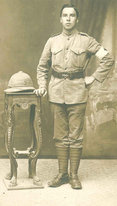
| Rank | |
|---|---|
| First Name | Alfred J. |
| Surname | Arnold |
| Year of Birth | Unknown |
| Year of Death | Unknown |
| Regiment | Royal Army Medical Corps |
| Place of Wartime Residence | Whittlesford, Cambridgeshire |
Alfred J.'s Story
Alfred J. Arnold, a trained teacher, served as a Private in the RAMC from May 1916 to December 1918. He was present at the Battle of the Somme (July - November 1916), an auxiliary military hospital in Lancashire (January - July 1917), an unidentified hospital in France (August - November 1917), and joined the 1/1st South Midland Field Ambulance (48th Division) in Italy (December 1917 to December 1918). This letter to his family provides graphic detail of the horrors of war.
the guns were going most of the time, often shaking the very earth
Letter Home
(extracts)
July 7th 1916
My dear Parents and Sisters,
[...] The convoy started off again at 2.20am Monday and we reached our new destination about 5am. [previously at Etaples].
After we had breakfast some of us started dressing wounds of patients who we found waiting here. When we arrived, there were 330 wounded and sick with about 20 men of a Field Ambulance to look after them. The number of casualties during the 'great offensive' had been more than could be dealt with. Some of the wounded had not had their wounds dressed for 2 or 3 days and had been living on Bully Beef and Biscuits. There are five huts here and they were full, and scores of wounded were lying about on heaps of straw and grass round about. Thus, although we had been travelling all night we had a good day's work before us.
[...] But as it is, the ground is terribly swampy. This afternoon we had a very heavy storm and as we have the bare grass for the floors of our marquees, the water was springing up from below and forming small pools all over the place. Luckily we have stretchers to sleep on so we do not have to sleep actually in the water. I can't understand how the poor chaps in the trenches can exist when they stand for days in water up to their waists.
[...¦] When the wind blows in the right direction we can hear the guns quite distinctly but everything round about seems so peaceful and quiet that it is hard to realise that nearly every boom means disaster and death. As we came from our old camp we lost the way and came to a point fairly near the firing-line, from which we could see the shells bursting, see the aeroplanes over the trenches and the 'captive balloons.' We thought we were going into the thick of it at first but then we had to go back some miles, so we are now out of harms way.
[...¦] The results of the 'great offensive' were painfully demonstrated by the numerous train loads of wounded, and motor ambulances which we saw en route. At one siding I saw four trains emptied in a comparatively short time and while this was in progress, trains full of wounded passed by to their various destinations. In one case a train was being emptied of our wounded at the rear and being filled at the front with wounded off to Blighty. The chaps working in the hospitals are 'at it' night and day alike. On two trains there were about 200 German wounded. Poor beggars, they were knocked about too. One or two had died on the train and others were dying. No-one who has not seen can realise how badly some of them were mutilated. I was pleased to see how kindly they were treated by the English stretcher bearers and RAMC men. [...]
Text published by the BBC with permission from the soldierÂ’s relatives and the Imperial War Museum.


No additional memories have been submitted