

Soldier Record
Robert William Davison
Contributed by: Paul D. Taylor, on 2008-12-26
| Rank | |
|---|---|
| First Name | Robert William |
| Surname | Davison |
| Year of Birth | 1890 |
| Year of Death | 1971 |
| Regiment | Durham Light Infantry |
| Place of Wartime Residence | Seaham, Durham |
Robert William's Story
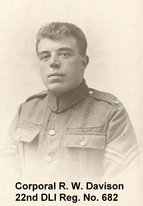
Corporal Robert William Davison 22nd DLI, 'D' Company, Regimental No. 682.
"in the event of my death I give... my Iron Rations to John Bull"
DLI Pioneer Corps "Dirty Little Imps"
Robert William Davison of Seaham 1890-1971
Oldest of 5 children, having a brother, Leslie, and 3 sisters.
Trade: Mason
Date of attestation 7/12/1915.
Bob and his younger brother Leslie served alongside each other, the elder brother trying to look out for the younger.
Bob was wounded in action on 11/07/17 (a shrapnel wound to the thigh, I believe) but returned to the front when healed.
Some early newsreel footage of Bob is believed to exist showing him disembarking from a steam ship during a brief absence of leave to visit his terminally ill mother (13/12/17-17/12/17).
The brothers were taken prisoner in the confusion of battle during the German Spring Offensive of 1918, when Bob was slowed-down because he was carrying his wounded brother on his back. I believe Leslie suffered chest wounds. Bob’s Pay Book records the date and place of capture as 25/03/18, Hattencourt, St Quentin.
The brothers were separated for the remainder of the war and Bob did not know whether his brother was alive or dead until they were re-united in December 1918.
In the PoW camp Bob built a bread oven and was rewarded by his captors: they gave him a pair of shoe laces though all he had to wear on his feet were wooden clogs ! The Germans, their prisoners and the local French people suffered food shortages alike.
Bob was released from a camp at Vosges in the Lorraine Region of France (near St. Dié) on 15/11/1918 and discharged from the army on 17/02/1919.
After the war Bob told stories of terrific artillery barrages; of “fixing bayonetsâ€Â, whistles and comrades “going over the topâ€Â. Of physical carnage and men driven mad. Of mud and vermin; of trench feet and trench life. Of no-man’s land illuminated by ‘Vary Lights’, of shell holes and battlefields …and of ‘bully beef’ and ‘hard-tac’ biscuits.
Stories too of the time in prison camp: enormous gratitude to the people of Lorraine who passed food “under the wireâ€Â; other stories of nettle soup and… dog’s eyes soup !
Despite the carnage and the hardship Bob, like many soldiers, retained a sense of humour. The Will he wrote in his final Pay Book reads;
"In the event of my death I give the whole of my property and effects to my father -
Mr Watson Davison, 17 Lord Street, Seaham Harbour, Co. Durham -
My Iron Rations to John Bull."
Returning to civilian life Bob married Edith Williams of Redcar (1896-1952). They lived in Seaham and raised a daughter.
Bob worked as a bricklayer for the North East Brewery and after the 1927 merger, Vaux Breweries. His “war service†not quite done, during the 1939-45 war Bob built a deep air-raid shelter for family and neighbours which was renowned for being dry and cosy (unlike the majority that suffered from dampness and cold) and he served as a fire-watcher on the brewery roof, in Sunderland.
Happiest working, Bob continued bricklaying well into his 70s and tended an allotment until his death, providing vegetables to the neighbours in the terraced streets of cottages free of charge.
Presumably like many who survived the trenches, Bob considered every extra day of life a bonus. Often in his later years he would remember comrades, the place names synonymous with the The Somme, and the sayings “better to die on the battlefield than on a rusty old bedstead†or “praise the Lord and pass the ammunitionâ€Â. Also, presumably thinking of his wife, “better to have loved and lost than never to have loved at allâ€Â.
Remembrance Day was inevitably a very emotional day for him, every year.
(See also Private Leslie Davison, 22nd DLI).
Other memories
Bob's own commentary, written on the back of the photo-postcards in the associated photo gallery.
2. Improvised Trestle Bridge, 22nd DLI at Catterick camp.
I had it rough but I enjoyed my army days. Happy days, not half.
Man O : Sergeant Garbett of Binchester
Man X : [Bob]
Man XX : My pal from Shields, Fred Renton, a fruiterer’s son -
- We both got captured. We got parted after 3 months and I have not seen him since.
A great lad tough. He had a hard battle behind the lines with an Irish man. When the fight was on a lot of Irish blokes tried to get at Fred but I stopped them and he knocked the stuffing out of the bloke. The Jerries did enjoy it.
[The 'Jerries' possibly referring in this context to German Prisoners of War ?]
Bob's own commentary, written on the back of the photo-postcards in the associated photo gallery.
3. Brothers Leslie and Bob Davison.
"Brothers both captured 25th March 1918, St. Quentin front, France [at Hattencourt].
I was carrying Leslie out wounded.
We got parted and I didn't see Leslie till after the war" December 1918.
Leslie died in November [mid 1930s ], 40 years old, war wounds.


Bob's own memories, written on the back of the photo-postcards added to the gallery.
1) Armentieres Woods 1917 :-
Tom Coulson, gamekeeper, killed 1917.
Alf Gardner (middle standing man), came home and died.
Tom Manan (Darlington), killed 1917
[Bob himself is the person sitting in the photograph... and appears to have been the only one to have survived the war.]
Complain about this post