

Soldier Record
William Harris
Contributed by: Anne-Marie Harris, on 2008-11-11
| Rank | |
|---|---|
| First Name | William |
| Surname | Harris |
| Year of Birth | 1884 |
| Year of Death | 1915 |
| Regiment | Duke of Wellington's Regiment |
| Place of Wartime Residence |
William's Story
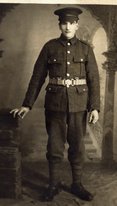
William Harris was born in Salford and moved to Bolton with his family in 1895. A member of the Territorial Army, he was mobilised when the war started and enlisted in Huddersfield in August 1914. He joined the Duke of Wellington (West Riding) Regiment 2nd Battalion. His service number was 11511. Family legend says that at Christmas 1914, he returned home on leave and said he would not be coming back. He died on 5th of May 1915. Our family always claimed he died “under†Hill 60 during tunnelling operations and recounted stories of underground hand-to-hand combat. His great, great nephew, John, has done some research into this theory and whilst the description of tunnelling operations is true, finds it unlikely that William died in this way. Tunnelling was carried out by special Tunnelling Battalions recruited from the coal mines and in the case of hill 60 usually from South Wales. These battalions sometimes worked with ordinary infantry battalions but he could find no evidence of the Duke of Wellington Regiment being one of them. There was a lot of tunnelling in the Ypres area, and Hill 60 in particular, but no large mines were exploded at Hill 60 on the day William died.
On May 4th the 2nd Battalion Duke of Wellington Regiment was on top of Hill 60 not under it. They had relieved the Devon’s and had taken up a defensive position by 3:30am. The next morning, just before 9am the Germans launched a devastating gas attack on the hill. William’s battalion was almost completely wiped out. There is a small chance he died in a tunnel but we think it is more likely he was overcome by gas during the initial attack, although he may have survived the first onslaught and died some time later in the day. John believes his mother, sisters and nieces were told he was blown up rather than gassed as this was considered a less traumatic death for them to deal with. There remains a small chance that he was attached to a mining company and died in the tunnels.
William was 31 when he died. He has no known grave but is commemorated along with 60,000 others on the Menin Gate. He was one of five brothers who fought in WWI. His younger brother Cyril died in a prisoner of war camp and another brother, Arthur, lost his leg. His two elder brothers survived the war and our family descends from the eldest, Robert. My son, Mark, visited Ypres and the Menin Gate on November 7th 2008 on a school trip and found William’s name on panel 20. He was born in May 1995 into this free world that William fought and died for 80 years earlier.


No additional memories have been submitted