

Soldier Record
Herbert Smart
Contributed by: Stephen Cooper, on 2008-11-09
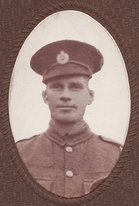
| Rank | |
|---|---|
| First Name | Herbert |
| Surname | Smart |
| Year of Birth | 1878 |
| Year of Death | 1918 |
| Regiment | Cheshire Regiment |
| Place of Wartime Residence | Kingsthorpe, Northamptonshire |
Herbert's Story
Herbert was 37 years 11 months old and only 5 feet 2 ¾ inches tall on volunteering for active duty at Northampton . He joined the Royal Engineers on the 23rd August 1915 . On the 1 August 1916 whilst training as a sapper at Killinghall camp he was caught out of bound, trespassing on Pot Bridge Farm. His punishment being 2 days confined to barracks.
Whilst we remember, the sacrifice is not in vain
Herbert was subsequently transferred to the 16th Cheshire Regiment , which was a Bantam regiment consisting of men who would not normally meet the height requirement of the British army. Private Herbert Smart Service No: 58002 was ordered to France in September 1916. On 30 December 1916 he travelled from Southampton to Rouen joining the BEF
Via the 9th Cheshire regiment he was posted to the 16th Cheshire Regiment on the 13 January 1917. Soon after this he was again in trouble ,"whilst on active service conduct to the prejudice of good order and military discipline in that he in the field on or about 4-2-17 signed on a green envelope AFW3078 the certificate that the contents of the said envelope referred to nothing but private and family matters well knowing that the contents of the said envelope was not as described in the said certificate. Herbert was tried on the 3rd November He was found guilty and sentenced to 60 days field punishment confirmed by Brig General Marindin commanding 105 infantry brigade who directed that 39 days of the sentence be remitted.
According to National roll of the Great War 1914-1918 Herbert fought and survived the Battle of Arras but on the 22 October 1917 he was injured ,sustaining gunshot wounds to his legs . On this date the 16th Cheshire's were involved in a diversionary attack east of Poelcapelle and the ground south of Houlthulst Forest. Herbert arrived back in Blighty on the 3rd November 1917 probably to recover from his wounds. Time at "Home" ended on the 23rd of May 1918 when he travelled back to France.
Again via the 9th (service ) Battalion he proceeded to the 15th Cheshire battalion on the 1st of June 1918 joining them in the field on the 5th of June 1918. This is around the time when tide of war was turning in favour of the Allies and whilst holding positions in the St. Jan Cappel sector the Cheshires were able to see the Germans torching buildings as they retreated. Throughout September the Battalion rotated in and out of the trenches between Western edge of Zillebeke lake and the canel at the intersection of the Ypres- Lille road. They were also involved in an attack where they were to capture the line between Tenbreiken Village to Blagnaert Farm which was conducted in heavy mist and rainfall. Despite heavy losses due to heavy bombardments of explosive and gas shells and machine gun fire their objective was finally reached. This was the end of trench warfare for the Cheshires and they now were chasing the enemy across open land
The Cheshire Battalion crossed the River Lys just before midnight on the 19th of October ,halting briefly near the tile works in Marckbeeke. Several hours later they moved to the village of Pottleberg, south of Courtrai The brigade launched an attack on objectives to the South east of Courtrai. They managed to capture the village of Berkstraatand and a neighbouring ridge. The battalion then encountered heavy machine gun fire but pushed forward crossing the river Keibeek finally reaching their first objective . The days fighting cost the battalion fifty casualties including seven dead ,one of these being Herbert Smart. He was buried in the vicinity of Courtrai but his body was later exhumed and re-interred in Harlebeke New British Cemetery North east of Courtrai Plot 7,Row "d" grave 12.


No additional memories have been submitted