
Unitarianism as an organised church grew out of the Protestant Reformation of the 16th century CE. It started in Poland and Transylvania in the 1560s, and was recognised as a religion in Transylvania within 10 years.
History of Unitarianism
Last updated 2009-09-21
History of Unitarianism
Beginnings
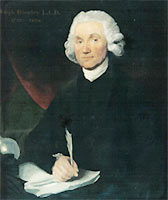 Joseph Priestley ©
Unitarianism as an organised church grew out of the Protestant Reformation of the 16th century CE. It started in Poland and Transylvania in the 1560s, and was recognised as a religion in Transylvania within 10 years.
In England, Unitarian ideas were being discussed by the mid 1600s in the writings of John Biddle (1615-62), and the first Unitarian congregation came into being in 1774 at Essex Chapel in London, founded by a former Church of England minister, Theophilus Lindsey.
The distinguished scientist and minister Joseph Priestley also played a key role in the formation of the movement.
North America
There are about 225,000 Unitarian Universalists in the USA and Canada, and about 1,000 congregations.
The North American version has much in common with the UK version but includes additional ideas brought in when Universalist Church of America (founded in 1793) and the American Unitarian Association (founded in 1825) merged in 1961 to form the Unitarian Universalist Association. The Canadian Unitarian Council represents the Canadian congregations.
The North American church has for many decades been much more 'humanist' than Unitarian churches elsewhere in the world. Recently, however, there has been a movement in the Unitarian Universalist Association to be more accepting of what its President calls the "language of reverence". This seems to be the result of the rising influence of a younger generation that is more attuned to spiritual values (or that has had fewer bad traditional church experiences).
Today Unitarian Universalism encompasses liberal Christians, Jews, Buddhists, humanists and followers of earth-centred spirituality (neo-pagans) within its ranks.
Historically, the North American Unitarian movement is not a child of the European movement. Although it benefited from immigrants and visitors from Europe (such as Joseph Priestley, who also discovered oxygen), it was largely a reaction against the "Great Awakening" of the 1740s and the Calvinist ideas that it contained.
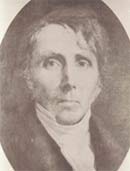 William Ellery Channing ©
Although the early American Unitarians did abandon the doctrine of the Trinity, they gave greater importance to moving to a religion based on reason, and in adopting a hopeful view of human nature rather than seeing humanity as fallen and sinful.
A turning point came in 1819 when William Ellery Channing gave the sermon 'Unitarian Christianity', which became the key text for liberal religion in North America. In this sermon he set out the foundation stones:
- the unity of God and the rejection of the Trinity
- the importance of reason in understanding the Bible
- the importance of human nature in discovering religious truth
- God as having a loving and parental nature
- rejection of the doctrine of original sin
Within 20 years the movement was influenced by the Transcendentalist ideas of Emerson and Thoreau.
These distinguished American writers emphasised intuition as the source of knowledge and believed that that God is present in every individual and throughout the natural word.
The intuition of the moral sentiment is an insight of the perfection of the laws of the soul. These laws execute themselves. They are out of time, out of space, and not subject to circumstance.
Thus; in the soul of man there is a justice whose retributions are instant and entire. He who does a good deed, is instantly ennobled. He who does a mean deed, is by the action itself contracted. He who puts off impurity, thereby puts on purity.
If a man is at heart just, then in so far is he God; the safety of God, the immortality of God, the majesty of God do enter into that man with justice.
Ralph Waldo Emerson July 15, 1838
BBC iD
BBC iDBBC navigation
BBC links

BBC © 2014The BBC is not responsible for the content of external sites. Read more.
This page is best viewed in an up-to-date web browser with style sheets (CSS) enabled. While you will be able to view the content of this page in your current browser, you will not be able to get the full visual experience. Please consider upgrading your browser software or enabling style sheets (CSS) if you are able to do so.

