
This article looks at the distinction between 'religious' and 'philosophical' Taoism, which is the difference between the practices of the faith, and the theological ideas behind them.
Religious and philosophical Taoism
Last updated 2009-11-12
On this page
Page options
Religious and philosophical Taoism
Religious and philosophical Taoism
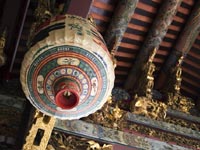 Lantern in a temple ©
The word Taoism is used to refer to both a philosophy and a set of spiritual doctrines as well as an extensive ritual hierarchy and monastic institution. Although textbooks often distinguish between 'religious' and 'philosophical' Taoism, this is an artificial distinction, and is no more than the difference found in all religions between the practices of the faith, and the theological and philosophical ideas behind them.
Chinese and Western Taoist philosophy
A more useful distinction might be between Chinese Taoism and Westernised Taoism because some forms of Westernised Taoist philosophy add unauthentic new age and other faith elements to Taoism, while removing much of its religious content; and few Western 'Taoists' include Taoist gods and goddesses, liturgy, worship, or specifically religious meditative practices in their religious life.
Religious Taoism
Taoism in the West today is not at all like Chinese Taoist religion. Very few Westerners have adopted its gods and goddesses, although there are a few organizations... that have installed altars in their centres, worship Taoist gods, and celebrate Taoist (and Buddhist) festival days.
Livia Kohn, Michael Lafargue, Lao-Tzu and the Tao-Te-Ching, State University of New York Press, 1998
Taoism is often taught in the West as an atheist or agnostic philosophy, but in China and Taiwan particularly, Taoism still functions like any conventional religion, and not like an abstract philosophy of life.
There are Taoist temples, monasteries and priests, rituals and ceremonies, and a host of gods and goddesses for believers to worship. These are as vital to the survival of Taoism as individual understanding and practice.
Taoism's rich palette of liturgy and ritual makes the Tao more real to human beings and provides a way in which humanity can align itself more closely to the Tao to produce better lives for all.
The religious elements of Taoism draw much of their content from other Chinese religions (including many local cults), and so enfold a very wide range of culture and belief within the wings of the Tao.
The many traditions within the Taoist framework gives priests the tools to carry out the conventional tasks of any religion: worship, healing, exorcism, intercession, purification, divination and so on.
Most Taoist temple practices are designed to regulate the relationship between humanity and the world of gods and spirits, and to organise that relationship, and the relationships in the spirit world, in harmony with the Tao.
Religious Taoism traditions
Two traditions
Religious Taoism follows two main traditions. Each has a clear hierarchical and well-organised structure with special headquarters, rules, guidelines, ordination rites and registration procedures.
The celestial masters (Tianshi or Zhengyi) - Temple Daoism are centred in Taiwan. The monastic branch of the Complete Perfection School (Quanzhen) has its headquarters in Beijing.
The Complete Perfection School ordains people and provides monastic communities as a focus for Taoist practice and rituals.
A simple, ascetic lifestyle is the norm in Daoist monasteries. They are ruled by a strict hierarchy, with the abbot at the head, the prior as the key manager of personnel (assisted by an overseer and several scribes), the provost as main administrator (assisted by a superintendent, treasurer, cellarer, as well as several vergers and cooks), and the meditation master in charge of spiritual practice (assisted by an ordination master, manager of offerings, and several overseers).
The time schedule is very rigid: a typical day begins at 3:00 A.M. and ends at 9:00 P.M. It consists of several periods of seated meditation, worship, meals, and work, including- musch as in Chan Buddhism-work in the gardens and the fields. Everybody is kept busy at all times, and all movements throughout the day are exactly prescribed and have to be executed with utmost control. Usually meditation, sleep periods, and meals are times of complete silence, and even at other times words are to be used with care and circumspection. Daoists, moreover, observe the natural cycles of the seasons and often eschew the use of artificial lights, so that their winter days are a great deal shorter than those in summer, allowing for more extensive rest in the darker phases of the year.
Livia Kohn, Daoism and Chinese Culture
Taoist priests
Taoist priests undergo long and intense training to acquire the necessary skills. They must study music, liturgy and ritual, as well as meditation and other physical practices; and they must learn Taoist theology and the spiritual hierarchy of the Taoist deities. During this training they are required to live highly disciplined lives.
Shamanism
Taoist experts believe that they can journey in spirit to higher realms of being - in much the same way that Shamans can journey out of the body.
The Taoist traveller makes such journeys through ritual, meditation, and visualisation which separate them from this world and harmonise them with the energy flows of the universe. The journeys gradually move them closer and closer to the Tao itself.
Elsewhere on the web
BBC iD
BBC iDBBC navigation
BBC links

BBC © 2014The BBC is not responsible for the content of external sites. Read more.
This page is best viewed in an up-to-date web browser with style sheets (CSS) enabled. While you will be able to view the content of this page in your current browser, you will not be able to get the full visual experience. Please consider upgrading your browser software or enabling style sheets (CSS) if you are able to do so.

