
Rastafarian music, including traditional Nyabingi chants, drumming and reggae.
Rastafarian music
Last updated 2009-10-09
Rastafarian music - Nyabingi
The traditional music of the Rastafarian religion is Nyabingi.
Nyabingi music is used during reasoning sessions and consists of chanting and drumming to reach states of heightened spirituality.
The chants contain ideas of black redemption and repatriation. They help people to participate and feel included in the Rastafarian community.
Nyabingi music consists of a blend of 19th century gospel music and African drumming.
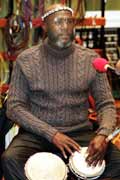 A Rastafarian man drumming at a reasoning session ©
19th century gospel music
The music of early Rastafarians was not specific to their religion alone. Early Rastafarians used music and hymns created by Sankey and Moody, two very influential 19th Century American evangelists who travelled throughout the world. The Rastafarians took such hymn tunes and set them to their own words, usually reflecting the importance of Africa.
African drumming
An early African musical influence was Burru Music. This type of music was sung by African slaves to keep their spirits up whilst working. As the slaves had no religion and the Rastafarians had no music, it seemed natural for the Rastafarians to adopt Burru music, while welcoming slaves as new converts into their religion.
Spread and development of Rastafarian music
In the 1950s, Count Ossie began using drumming during reasoning sessions. He realised that this drumming intensified the spiritual effects and heightened people's sensations.
Count Ossie began developing rhythmic patterns that spread throughout the Rastafarian community. Count Ossie played this music publicly, resulting in the spread of the Rastafarian message.
This type of music requires the use of three types of drum: the bass, fundeh and peta (repeater).
Reggae
In the last thirty years Rastafari has become commonly associated with Reggae music, especially following the worldwide success of Robert Nesta Marley.
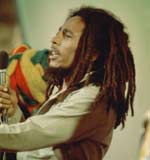 Bob Marley
 Bob Marley, as he was commonly known, helped spread awareness of the religion among outsiders through his appearances and his lyrics.
Many people believe that Bob Marley was the main factor in the spread of Rastafari to the USA, Canada, most of Europe, Africa and Australasia.
His lyrics were influential in the spread of political and social ideas of the Rastafarian movement. He spoke out against the inequality experienced by the black community and the negativity they were subjected to.
Marley's lyrics expanded the Rastafarian teachings:
We are sick and tired of your ism-schism game, to die and go to heaven in Jesus' name. We know and understand almighty God is a living man.
Bob Marley, Get Up, Stand Up, Tuff Going Music, 1973
These lyrics re-state the Rastafarian teaching of the suppression of blacks by whites, and the understanding that Haile Selassie is the Living God who will eventually redeem the Rastafarian community.
We know where we're going, we know where we're from. We're leaving Babylon, going to our Father's land.
Bob Marley, Exodus, Music BVI/Rondor Music, 1977
This refers to the repatriation themes of Rastafari and the return, from Babylon and its suppressors, to the promised land of Africa.
BBC iD
BBC iDBBC navigation
BBC links

BBC © 2014The BBC is not responsible for the content of external sites. Read more.
This page is best viewed in an up-to-date web browser with style sheets (CSS) enabled. While you will be able to view the content of this page in your current browser, you will not be able to get the full visual experience. Please consider upgrading your browser software or enabling style sheets (CSS) if you are able to do so.

