
This article provides information about one of the best-known Svetambara Jain ceremonies, the eightfold puja (eightfold offering).
Eightfold puja
Last updated 2009-09-14
Eightfold puja
One of the best-known Svetambara Jain ceremonies is the eightfold puja (eightfold offering). This involves the worshipper making eight symbolic offerings to the image of a tirthankara.
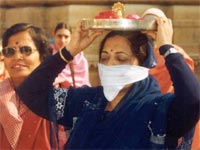 The worshipper walks three times clockwise round the images ©
Some of the symbolism is outlined below, but there is no official code of symbolism, so different Jain groups will have different ideas about it.
One idea common to many groups is that the various offerings are not so much a gift to the tirthankara (which would be pointless) but a giving up of them by the worshipper in a gesture of renunciation.
Before worship
Before the ritual the worshipper washes themselves and puts on clean unstitched clothes that are normally used only for worship. These clothes are never used when eating or going to the toilet.
On the way to the temple the worshipper stops thinking of worldly things and prepares themselves mentally for worship.
At the temple
Worshippers enter the temple and say "nisihi". This means "giving up" and indicates that they are moving from the secular activities into spiritual ones. They say it again as they enter the inner room that contains the images of the tirthankaras.
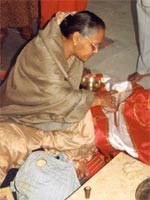 A worshipper making the eight symbolic offerings ©
The worshipper walks three times clockwise round the area containing the images to symbolise the three jewels of right faith, right knowledge, and right conduct. There are set texts to be chanted during this.
Then the worshipper makes 8 offerings:
- Water: poured on the image, to cleanse it and to symbolise purity
- Sandalwood and saffron paste: dabbed on the key parts of the image. Sandalwood is thought to cool fever, so this action symbolises cooling the passions
- Flowers: a garland round the image symbolises faith in the teachings, or forgiveness, or the fragrance of the three jewels
- Incense: waved at the image to symbolise the removal of ignorance and desire, or the burning away of karmic particles
- Light: a lamp is waved towards the image to symbolise enlightenment destroying the darkness of ignorance, or the suppression of activity
The last three offerings are made at a distance from the image:
- Rice
- Sweets
- Fruit
The food offerings are arranged symbolically on a table:
Rice is shaped into a swastika: the four corners of the swastika symbolise the four states into which a soul can be born - human, plant/animal, heavenly being, hell being.
Three dots are made above the swastika to symbolise the three jewels of right faith, right knowledge and right conduct. Above those comes a crescent with a dot above it, which symbolises the liberated beings at the very top of the universe.
The worshipper then adds fruit and other food, and money to the offering.
Finally each worshipper spends time in prayer and contemplation of the image.
BBC iD
BBC iDBBC navigation
BBC links

BBC © 2014The BBC is not responsible for the content of external sites. Read more.
This page is best viewed in an up-to-date web browser with style sheets (CSS) enabled. While you will be able to view the content of this page in your current browser, you will not be able to get the full visual experience. Please consider upgrading your browser software or enabling style sheets (CSS) if you are able to do so.

