
The al-Burda is an Arabic poem honouring the Prophet Muhammad. It was written in the 11th century by Imam al-Busiri during his illness.
al-Burda
Last updated 2009-06-30
al-Burda
The al-Burda, also called Qasida (hymn) Burda, is an Arabic poem honouring the Prophet Muhammad. The name means 'poem of the mantle' or 'of the cloak'.
It was written in the 11th century by Imam al-Busiri and forms part of a vast body of literature in praise of the Prophet that emerged from an Islamic culture where seeking knowledge of him was encouraged. Imam Al-Busiri both acknowledges this and the shortcomings of describing the Prophet in the poem itself.
He is like the sun, small to the eye when seen from afar,
But when glimpsed close up. It dazzles and overwhelms.al-Burda
In order to see this content you need to have both Javascript enabled and Flash installed. Visit BBC Webwise for full instructions
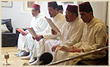 Fez Singers ©
The famous Mamluke minister Ibn Hinna, who served under the legendry sultan Barbys, took Imam al-Busiri under his patronage and freed him to write his poems in material security.
However, art often suffers when the artist is freed from suffering, and comes to life when calamities call. His greatest poem would result from a powerful tribulation: he woke up to find he was paralysed; half his body without movement. Suddenly, this man, whose erudition and art had elevated him to the status of prince of poets of his time, was reduced to an invalid unable to rise from his bed. This state of affliction stirred him to write the Burda.
...I began to contemplate writing a poem in the qasida form, and soon after, I did so as a way of interceding by it with the Messenger of God to God, the Exalted, hoping that he might heal me.
I was repeating it often, singing it, calling upon God through it, and seeking intercession with it. During that time, while sleeping, I saw the Prophet, upon him and his family be prayers and peace. He wiped over my face with his blessed hand and thrust upon me his cloak. I immediately got up and left my house. I had told no one of my poem nor of anything I had been doing prior to that.
On the road, I met a fellow spiritual wayfarer, who said to me, "I want you to give me a copy of the poem you wrote in praise of the Prophet, upon him be prayers and peace."
I responded, "which one?"
He said, "The one you wrote during your illness."
He then recited its opening lines saying, "By God, I heard it in a vision last night recited in the presence of God's messenger, upon him and his family blessing and peace. It greatly pleased the prophet, and I saw him thrust his cloak on the one who wrote it!"
I provided him with a copy, and he began telling others of his vision. Thus its news spread far and wide.
Imam al-Busiri
Imam al-Busiri died in Alexandria, Egypt in the year 1295 CE. His grave is well known and is connected to a large mosque. His poem embellishes its walls.
The Burda was also engraved on the Prophet's mosque in Madina. There it adorned its walls and reminded believers for centuries before being erased by people who could not comprehend it. There is still one line left that has not been removed:
He is the beloved whose intercession is hoped for
As arms against a host of relentless calamities.al-Burda
BBC iD
BBC iDBBC navigation
BBC links

BBC © 2014The BBC is not responsible for the content of external sites. Read more.
This page is best viewed in an up-to-date web browser with style sheets (CSS) enabled. While you will be able to view the content of this page in your current browser, you will not be able to get the full visual experience. Please consider upgrading your browser software or enabling style sheets (CSS) if you are able to do so.

