
The Taizé community is an ecumenical monastic order with a strong devotion to peace and justice through prayer and meditation.
Taizé
Last updated 2009-08-10
On this page
Page options
Taizé worship
Taizé
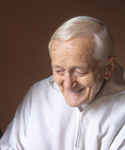 Brother Roger ©
The Taizé community is an ecumenical monastic order with a strong devotion to peace and justice through prayer and meditation. The 100-strong community of Roman Catholic and Protestant monks is drawn from 30 countries across the world.
It was founded in 1940 by Roger Louis Schutz-Marsauche (known as 'Brother Roger'). The 90-year-old monk died in August 2005 after being stabbed during a prayer service.
Today Taizé is one of the world's most important sites of Christian pilgrimage. Each year tens of thousands of young pilgrims flock to the small village of Taizé in central France to share in the community's way of life.
Prayer and silence are at the heart of the Taizé experience. Young people from every corner of the globe are encouraged to live out the Christian gospel in a spirit of joy, simplicity and reconciliation.
Ecumenism (a movement promoting Christian unity among Churches) is the key to Taizé's appeal, making it a magnet for people of many different cultures and traditions.
In order to see this content you need to have both Javascript enabled and Flash installed. Visit BBC Webwise for full instructions
Music
Taizé has spawned a unique style of worship that has become popular in churches, retreat centres and seminaries throughout the world.
The singing of distinctive and much-repeated prayer chants during candlelit prayer services is one of its trademarks. Taizé music highlights simple phrases, usually lines from the Psalms or other pieces of scripture, repeated or sung in canon. The repetition is designed to help meditation and prayer.
Prayer
Following the monastic tradition, the community gathers for common prayer three times a day.
The style of prayer is highly meditative. Singing and silence play a large part.
Prayer chants are sung in many different languages and include those from the Eastern Orthodox tradition.
The structure of prayer is similar to the Divine Office from the Catholic monastic tradition with a hymn, psalms, a scripture reading and intercessions.
Way of life
Way of life
Taizé monks are committed to material and spiritual sharing. They are also bound by vows of poverty, chastity and obedience. They dress as laymen but wear white hooded robes in church.
The community is self-supporting. The brothers live by their own work, refusing donations and personal family legacies.
Welcoming others has always been an essential part of Taizé life.
Visitors
Throughout the summer months, thousands of young people, aged 17 to 30, come to Taizé to explore or rediscover their Christian faith. They will typically camp in the fields around the church and monastery, joining in the community's worship three times a day.
They will also spend time studying the Bible, reflecting in silence and meeting in discussion groups.
Taizé's daily routine
Life in Taizé is centred on prayer. Following the Benedictine tradition Ora et Labora (Pray and Work), all pilgrims are expected to play a full role in community life, joining in cleaning tasks for the benefit of all.
A typical day in Taizé includes the following activities:
- morning prayer
- breakfast
- large group Bible study
- small group discussions
- midday prayer
- afternoon work or bible study
- discussion with the brothers
- dinner
- evening prayer
History
History
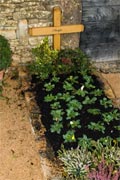 Tomb of Brother Roger
 Brother Roger (Roger Louis Schutz-Marsauche) set up the Taizé community after cycling to the Burgundy region of France from his home in Geneva.
The son of a Protestant pastor and the youngest of nine children, he was born in Provence, Switzerland on May 12 1915 to a Swiss father and a French mother.
From an early age he was conscious of the divisions between Protestants and Catholics but he was urged to look beyond them. At university, he first felt the call to monastic life.
He was also greatly influenced by his grandmother's tales of helping refugees during the First World War. This gave him a strong desire to reach out to the poor and oppressed.
Bringing new life to Taizé
He left Switzerland in 1940 travelling 70 miles before stopping in the semi-abandoned village of Taizé where an old woman offered him a meal.
She encouraged him to stay in the village which was close to the ruined abbey of Cluny.
He raised money to buy a disused house and outbuildings where he began to offer shelter to political refugees, including Jews fleeing Nazi persecution.
At first he prayed alone but a regular pattern of prayer with his guests soon became established. In 1949, Brother Roger set up a monastic community with Protestants and later with Catholics too.
In the post-war years, the monks received mainly orphans and former German prisoners. Brother Roger drew up a rule for the community including silence at meals, compulsory celibacy, the sharing of material goods and obedience to the prior, a role he assumed.
The monks set up a milk co-operative, published religious books and created a retreat centre for youth which today welcomes up to 5,000 young people each week.
In a public letter shortly before his death, Brother Roger spoke of the need to "love life on earth, and at the same time long for a beyond, a life that will never end."
People throughout the world mourned his tragic death on August 16 2005. He was stabbed by a woman three times in the throat during a Taizé prayer service attended by 2,500 people.
Brother Alois, a 51-year-old Catholic monk, was appointed his successor.
Worldwide, interfaith and the future
Taizé worldwide
As a concrete sign of solidarity, some of the brothers have gone to live among the most oppressed and poorest people of the world. Today they work in Africa, Asia, North and South America.
The initiative began in 1962 when the brothers began visiting Eastern Europe to help those close to their own borders.
In 1978 the community also launched the "pilgrimage of trust on earth", involving mass gatherings of young people and visits on every continent.
New Year European meetings
At the end of 1994, more than 100,000 young people from all over Europe met in Paris for five days of prayer and sharing.
The meetings take place in a large European city from December 28 to January 1 every year.
During the 2004 meeting Brother Roger told young people: "If we are at present undertaking a pilgrimage of trust on earth with young people from every continent, it is because we are aware of how urgent peace is. We can contribute to peace to the extent that we try to respond to the following question by the life we live: Can I become a bearer of trust where I live? Am I ready to understand others better and better?"
Church leaders
Taizé has a strong tradition of welcoming Church leaders. Pope John Paul II visited the community in October 1986. In his address to young people, he described Taizé as a "spring of water."
In 1992, the former Archbishop of Canterbury, Dr George Carey, spent a week in Taizé with 1000 young Anglicans from dioceses across England.
Since then other Church leaders have followed his example by coming to Taizé with their young people.
Future of Taizé
Undoubtedly, Brother Roger's inspiration and charism have been crucial in making Taizé so appealing to youth. His tragic death plunged the community into crisis and shocked people worldwide.
Taizé remains resolutely ecumenical, bringing together people from all denominations and cultures. It is a sign of hope in a divided world and its spirituality has brought new life to Christian churches throughout the world.
BBC iD
BBC iDBBC navigation
BBC links

BBC © 2014The BBC is not responsible for the content of external sites. Read more.
This page is best viewed in an up-to-date web browser with style sheets (CSS) enabled. While you will be able to view the content of this page in your current browser, you will not be able to get the full visual experience. Please consider upgrading your browser software or enabling style sheets (CSS) if you are able to do so.

