
A personal view of the Victorian Roman Catholic convert by Ann Widdecombe, herself a Catholic convert.
Cardinal John Henry Newman
By Anne Widdecombe Last updated 2011-07-06
On this page
- Introduction
- Newman and 19th century England
- Miracles key to the beatification process
- Newman's conversion
- Find out more
Page options
Newman: Saint or Sinner?
This article was published to coincide with Ann Widdecombe's authored BBC Two documentary, Newman: Saint or Sinner?, which first transmitted on 18th September 2010
Introduction
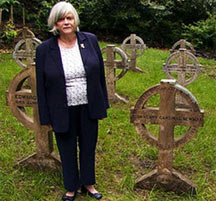 Ann Widdecombe at the grave of John Henry Newman.
 In 1993, when I converted from the Church of England to Roman Catholicism, several friends gave me Newman's Apologia pro Vita Sua. It was an apt choice because I was following where, more than a century earlier, this remarkable but very controversial figure had led.
Like Newman I had come from the evangelical rather than Anglo-Catholic wing of Anglicanism and like him had deep family roots in the C of E but my world was different. I did indeed receive hate mail but I faced no impact on my position, no rejection by friends and family, no loss of livelihood.
I spoke to Prof Diarmaid McCulloch of Oxford University about Newman's attractiveness to Catholic converts
Newman and 19th century England
In nineteenth century Britain life was very different. You could not go to Oxford or into Parliament if you were a Catholic. The Pope was widely held to be the anti-Christ and Newman's family was so upset by his decision that one sister never spoke to him again.
In order to see this content you need to have both Javascript enabled and Flash installed. Visit BBC Webwise for full instructions
Explaining to a public that is now largely theologically illiterate why it all mattered so much then and the significance of this Cardinal, who may be the first Englishman to be made a saint since the Reformation, posed a challenge of some proportions. Somehow I had to précis the theses of thousands of documents, set the historical scene, explain what beatification entails and crunch the essence of a complex man into a single hour.
Sitting at High Table in Trinity College and looking at the students I was struck by how different it would have seemed to Newman. In his day there would have been no women and a greater uniformity of race and clothing. Perhaps he would not have minded, for a look at the student accounts in his college archives reveals a young man who spent a great deal less than his contemporaries on food and drink. Newman was more interested in theology.
Miracles key to the beatification process
To be beatified involves a thorough analysis of every word ever written by the subject in case he demonstrated the smallest theological error or disobedience to the Church and similarly of every aspect of his life. Such was the size of Newman's output that the process took not years but decades, beginning at the Birmingham Oratory in the 1950s.
However no matter how holy the life nor how prodigious the works no one can commence the path to sainthood without a miracle having been effected in his name. In the case of Cardinal Newman that miracle has only recently been verified. One of the most dramatic moments in the documentary is testimony by the surgeon who treated the patient making the miracle claim.
A second miracle, even more surprising than the first, has since been claimed but has yet to be accepted by the Church and so is not in the programme. When people ask me if I believe in miracles I always say yes, often quoting the famous lines about Saint Bernadette of Lourdes: for those who believe in God no explanation is necessary and for those who do not no explanation is possible.
Newman's conversion
It was, nevertheless, not the dramatic parts such as the miracle or the memorable sermon in which Newman announced his decision to leave the Church of England, which made this documentary one of the most memorable experiences of my life but the peaceful ones. In Oxford, at Littlemore, a small group of devoted nuns keeps the memory of Newman alive.
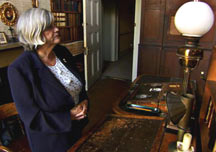 Ann Widdecombe in John Henry Newman's study.
 It was here that he lived, without actually being a monk, a monastic life, in a Spartan room; here that he wrestled with the dawning realisation that the Roman Church was, after all his previous protestant certainty, right here that he asked a Catholic priest to receive him: here that he parted from the security of all his moorings and set off to a new, somewhat uncertain life.
That sounds like turmoil but the atmosphere at Littlemore is one not of melodrama but of extreme peace which folds one in a gentle embrace as though the resolution of a man’s inner struggle before God has left its tranquillity behind. It was here that I felt closest to Newman, here that I seemed to breathe out after entering into the tension of his struggle.
In order to see this content you need to have both Javascript enabled and Flash installed. Visit BBC Webwise for full instructions
Around the BBC
BBC iD
BBC iDBBC navigation
BBC links

BBC © 2014The BBC is not responsible for the content of external sites. Read more.
This page is best viewed in an up-to-date web browser with style sheets (CSS) enabled. While you will be able to view the content of this page in your current browser, you will not be able to get the full visual experience. Please consider upgrading your browser software or enabling style sheets (CSS) if you are able to do so.

