
A description of Bahá'í worship, in which they try to know and love God.
Bahá'í worship
Last updated 2009-09-24
Bahá'í worship
Bahá'ís see themselves as a people with a mission to bring harmony and unity in the world, and this is reflected in their spiritual practice.
The main purpose of life for Bahá'ís is to know and love God.
Prayer, fasting and meditation are the main ways of achieving this and for making spiritual progress.
Meditate profoundly, that the secret of things unseen may be revealed unto you, that you may inhale the sweetness of a spiritual and imperishable fragrance...
Bahá'u'lláh
Service to others is worship
Bahá'í texts state that work performed in the spirit of service to humanity is a form of worship.
Absence of ritual
The Bahá'í faith has no clergy or sacraments, and virtually no rituals.
There are only three Bahá'í rituals:
There are two reasons Bahá'ís avoid ritual:
- Rituals can easily degenerate and become meaningless, so that people carry them out for the sake of the ritual and forget the spiritual purpose behind them
- Rituals can be a form of cultural imperialism, imposing the same rituals across different cultures and destroying their rich diversity
Shoghi Effendi wrote in 1949...
Bahá'u'lláh has reduced all ritual and form to an absolute minimum in His Faith. The few forms that there are - like those associated with the two longer obligatory daily prayers - are only symbols of the inner attitude.
Shoghi Effendi
Events and celebrations
Doing without rituals does not mean doing without celebrations or special events.
Communal worship
Bahá'ís have no liturgy, since the minimising of ritual makes it impossible to develop one.
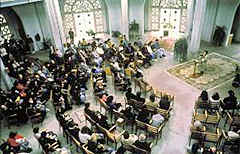
The emphasis on prayer and meditation, and on social action in Bahá'í thinking means that congregational worship plays a much smaller part in Bahá'í life than it does in other faiths.
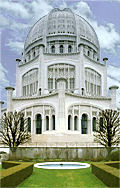
Bahá'í services are very simple with readings from the scriptures, along with interpretations of them and prayers. Hymns and poetry are allowed, but not common. The atmosphere is usually dignified.
Bahá'í are encouraged to come together in communal worship, but there are no congregational prayers. One person will recite prayers on behalf of everyone present.
This is because prayer is seen essentially as a private duty, and because there are no professional clergy within the Bahá'í faith.
Morning prayer
Bahá'í scripture recommends that the community should meet together for prayer each morning, although this is not commonly done by modern Bahá'ís.
Nineteen day feast
For modern Bahá'í the main occasion for group worship is the devotional portion of the nineteen day feast.
Holy days
Bahá'ís usually hold special worship events on holy days and festivals.
Elsewhere on the web
BBC iD
BBC iDBBC navigation
BBC links

BBC © 2014The BBC is not responsible for the content of external sites. Read more.
This page is best viewed in an up-to-date web browser with style sheets (CSS) enabled. While you will be able to view the content of this page in your current browser, you will not be able to get the full visual experience. Please consider upgrading your browser software or enabling style sheets (CSS) if you are able to do so.

