
This page explores how the theory of evolution and other scientific discoveries undermined the value of religion as an explanation of the world.
The discovery of evolution
Last updated 2009-10-22
The discovery of evolution
Science begins to undermine religion
 Charles Darwin at the time of the publication of The Origin of Species in 1859 ©
In the second half of the 19th century the theory of evolution put forward by Charles Darwin, and other scientific discoveries, undermined the value of religion as a way of explaining the nature and existence of the world.
Theology and Bible scholarship
During the 18th and 19th centuries, academic research began to undermine the literal truths of religion and throw doubt on the existence of God as a separate supernatural being.
The philosopher Thomas Hobbes had noted even earlier, in 1651, that Moses could not actually have written all the books of the Bible that were attributed to him.
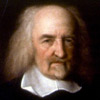 Thomas Hobbes ©
In 1779 J G Eichhorn suggested that the stories in the Book of Genesis, were not actual history, but were myths, like the stories of Greek and Roman mythology. Furthermore, he said, these stories should no longer be read as if they were the actual word of God.
Other theologians began to work with the ideas of Hegel to portray religion, and religious stories and beliefs in general, as symbolic ways of demonstrating truths about the spiritual life of humankind.
Literary analysis of the text began to cast great doubt on the Bible itself as a reliable historical document.
The German, D F Strauss, said in 1835 that the New Testament stories about Christ should not be interpreted as literally true, but as a dress of religious symbolism clothing the life of of a Jewish teacher.
God is a human invention
In 1841 Ludwig Feuerbach argued that God was a human invention, a spiritual device to help us deal with our fears and aspirations.
 Ludwig Feuerbach ©
This was bad news, because human beings projected all their good qualities onto God and saw him as compassionate, wise, loving and so on, while they saw themselves as greatly inferior. Thus humanity alienated itself from its true self.
Anthropology
Anthropologists, too, were casting doubt on previous certainties.
Research into comparative religion revealed that there was a great deal of similarity between the rituals and stories of many religions - even tribal religions seemed to have elements in common with Christianity.
This posed the big problem of how Christianity (or any other religion) could claim that it was the only true faith, and how any religion could claim to be the unique result of God's revelation, since all religions seemed to share so much in common.
Nietzsche
At the end of the 19th century the philosopher Friedrich Nietzsche (1844-1900) announced that God was dead, and that humanity had killed him.
 Friedrich Nietzsche ©
Nietzsche said that it was no longer possible to believe in the Christian God. Modern people, he thought, did not really believe in God any more and it was this unbelief that had killed off God.
This had serious ethical consequences. Western society's entire moral code was based on Judaeo-Christian ethics, and sooner or later people would realise that if they no longer believed in God, they could not live by a moral code that was based on God.
Nietzsche wasn't just proclaiming the death of God, but something even more radical - for Nietzsche there was nothing left to believe in, certainly not God, but not even any external world that might provide a source of meaning and purpose for humanity.
Nietzsche was particularly critical of Christianity. He thought that it was not only false but depraved and corrupt, a "contradiction of life".
BBC iD
BBC iDBBC navigation
BBC links

BBC © 2014The BBC is not responsible for the content of external sites. Read more.
This page is best viewed in an up-to-date web browser with style sheets (CSS) enabled. While you will be able to view the content of this page in your current browser, you will not be able to get the full visual experience. Please consider upgrading your browser software or enabling style sheets (CSS) if you are able to do so.

