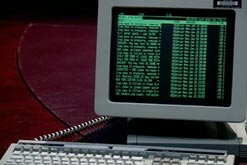
The word computer once referred to a person tasked with performing mathematical calculations. Today, computer typically means the machine sitting in front of you, a multi-purpose device that can be used for a range of tasks, from communication to digital photography. But pinpointing the birth of the computer in the modern sense is not straightforward.
Engineers might chart the history of the computer as physical object, whilst mathematicians might concern themselves with the computer as scientific idea. Thus Charles Babbage's "Analytical Engine", though never actually built, is often cited as the first programmable computer.
Babbage had been inspired by the high margin of error in the calculation of mathematical tables and set about building a device that could perform the tasks of a human calculator. Between 1833 and 1842 he worked on the Analytical Engine, a machine that stored programs on punched cards and that used mechanical cogs and wheels to do the working.
The first electronic computers were large and costly and were used to complete military objectives. During World War II, the Colossus at Bletchley Park had been utilised to break the "Fish" ciphers. The American ENIAC, announced in 1946, had been originally built to calculate artillery ballistics firing tables.
Stored program computers (computers that store its program in its own memory, rather than, for example, on a punched card) can be considered the precursor to the modern computer. These were developed in the late 1940s. However, it was the development of the microprocessor in the 1970s that was to usher in the age of the affordable "personal computer".