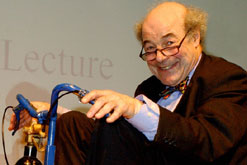
"Bioengineer" Professor Heinz Wolff was the first person to coin the phrase "Tools for Living" to describe any technology-based device intended to enhance the quality of life of anybody suffering from a disability.
In 1983 he founded the Institute for Bioengineering at Brunel University. He is now Emeritus Professor there and leads a team concerned with looking for technically innovative ways of solving major social problems.
He leads a double life, sharing his professorial duties with those of a scientific entertainer on Radio and TV and as a prolific lecturer.
The Bicycle
The first 'bicycle' was made of wood and invented in 1818 by Baron Karl de Drais de Sauerbrun.
The second had iron wheels, but instead of pedals it used cranks.
In 1868 there came the 'boneshaker'. It was very heavy but also very popular.
In 1870, James Starley developed the famous Penny-Farthing in England, so named after the largest and the smallest copper coins in the currency at that time.
The basic design has stayed the same since the end of the nineteenth century, however many refinements have been made over the last 100 years.
Perhaps the bicycle's most important legacy is its effect upon some women's emancipation. In the 1890s, women some women found they could cast off their impractical and uncomfortable clothing in favour of pantaloons. Outraged men claimed that the bicycle would allow women to travel beyond their usual geographical limits and away from the surveillance of their men folk.
Today, over one billion people in the world use bicycles and the bicycle is the principal means of transportation in many parts of the world.
Jo Hammond wrote: I nominate the bicycle as the most ecologically efficient method of transport and the first invention to really shake up the gene pool by enabling people to meet and marry outside their own villages.
The BBC is not responsible for the content of external sites