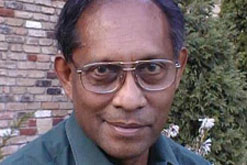
In 1974 Chandra Wickramasinghe first proposed the theory that dust in interstellar space and in comets was largely organic, a theory that has now been vindicated.
Jointly with the late Sir Fred Hoyle he was awarded the International Dag Hammarskjold Gold Medal for Science in 1986. Formerly a Fellow of Jesus College Cambridge, he is now Professor of Applied Mathematics and Astronomy at Cardiff University of Wales and Director of the Cardiff Centre for Astrobiology.
The Radio
Radio is a technology that allows the transmission of signals by varying the frequency of electromagnetic waves. The theory was first described in 1873 by James Clerk Maxwell
What we now call radio was first known as 'wireless telegraphy'. It's original inventor is unclear. But in 1893 in St Louis, Missouri, Nikola Tesla performed the first public demonstration of radio communication.
The person most closely associated with the invention of radio is Guglielmo Marconi. In 1896, Marconi was awarded the first patent for radio and his first 'wireless' factory was opened in England in 1898.
In 1906 Reginald Fessenden transmitted the first radio audio broadcast from Brant Rock, Massachusetts. It was heard by ships at sea and included Fessenden playing the violin and reading the Bible.
The world's first radio news programme was broadcast in 1920 by station 8MK in Detroit, Michigan. The first radio broadcasts by the BBC took place in 1922
Digital radio broadcasting began in the late 1990s.
The main uses of radio originally were for maritime purposes. The most famous example is in 1912 when operators aboard a sinking HMS Titantic communicated with ships nearby.