 |  | |
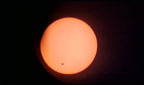
 Venus passing over the sun. Venus passing over the sun.
On Tuesday morning (June 8, 2004) at 6:18am, the planet Venus started to cross the face of the sun – an event which has not been witnessed by anybody alive on Earth.
Since the invention of the telescope, Venus has only passed across the surface of the sun six times, with the most recent being in 1882.
Astronomers call it a ‘Transit’, where a small astronomical object passes in front of a larger one. During a transit of Venus, the planet Venus passes directly between the Earth and the Sun. From the earth, observers looking through a specially adapted telescope or eclipse glasses, will witness a small circular silhouette creeping across the face of the sun.
Why are Transits of Venus so rare?
Venus orbits the Sun just over three times in the time it takes the Earth to orbit twice. This means that Venus passes between the Earth and the Sun roughly once every nineteen months.
However, there are at most two transits of Venus every century. This is because Venus and the Earth orbit the Sun at a slight angle to each other. When we watch from the Earth, Venus usually appears to pass above or below the Sun, rather than crossing it.
Dr Alan Longstaff, an astronomer who works at the Royal Observatory at Greenwich, explains why this is such a rare event “it is amazing that our mathematicians and scientists were able to predict this event to the minute.’ He went on to say that this is another example of humans co-operating to further understand the beauty of the universe.
‘The planet Venus is often referred to as Earth’s ‘sister planet’ as it is about the same size, mass, density and it’s made of the same sort of rocks – but you wouldn’t want a sister like this. The atmosphere is 90 times denser, so you would be crushed at the surface the temperature is about 460C, so you would be roasted. It is completely cloud covered and the clouds are concentrated sulphuric acid.’ Dr Longstaff said.
 Back to Reports Homepage Back to Reports Homepage
| | | | |
| | | | | |
| |
| |
|