 |  | |
 A glass of sparkling mineral water anyone? A glass of sparkling mineral water anyone?
You can't assume (committees are) going to be anything other than a ... time wasting exercise."
- Susan Greenfield
Whether it be at your place of work, on a local parish level, or for a multi-national corporation, committees are part of everyday life for many of us.
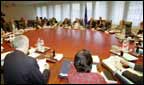
A meeting (or often a series of successive meetings) allows major issues to be worked through, everyone to give their opinion, ideas to be debated and group decisions reached.
Well that's the theory.
Not so in practice, argues Baroness Greenfield, a leading neuroscientist and Professor of Pharmacology at Oxford University.
"They waste people's time," she told Sarah, after penning an essay on the subject for the East of England 'Space for Ideas Campaign'.
She's not convinced that such a large congregation sitting around a table and working through issues is necessarily the best way to solve a problem or reach a goal.
"By definition a committee is more than two people and the bigger it is then the harder it is to get a word in edgeways and the more time you have to spend listening to everyone air their views," she argued.
"The problem with committees is that there's a consensus mood that operates and if someone wants to say something original, or different, or out of line, the social pressure not to do so is quite great."
As well as suppressing creativity, she also believes there's a form of herd mentality that prevails when a large group of people are sat around a table, nibbling on biscuits and drinking highly expensive bottled water.
"Quite often they'll say the same thing, so therefore there's a great amount of redundancy. On the whole you can't assume that it's going to be anything other than a … time wasting exercise."
But not everyone's so sure they're such a fruitless procedure. Sir Christopher Frayling is the head of the Arts Council and is on more than his fair share of committees. He used to be on far more. When taking up his current job he lightened his workload, shedding his position on no less than 16 committees of various descriptions.
For Sir Christopher, it's the implementation that can sometimes lead to a lack of productivity, not the principle itself.
"It's not just to do with how they're run, it's to do with who's on them," he insisted. "In certain walks of life you do get people who, say in academic life, are never going to write 'the great book' and they retreat into committee-land ... and shuffle paper and play games with agendas."
But when they work, claims Sir Christopher, they work. "If you get the right mix of people ... talking about an issue that excites them and you've got the right terms of reference, I think committees can be extremely effective."
Email us YOUR thoughts on 'committees' and meetings in general. Are they valuable forums, or an anti-productive exercise in grand-standing?
Find out more about the East of England 'Space For Ideas' campaign.
 Back to Reports Homepage Back to Reports Homepage
| | | | |
| | | | | |
| |
| |
|