| |

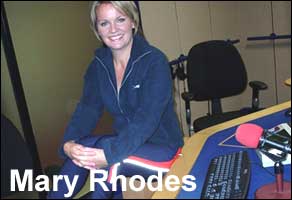
Mary Rhodes is one of Today's sports presenters. She'll be running the London Marathon in April 2006 and each month will share with us the pain and strain of getting fit for the challenge.
| | | |
| | | | | | USEFUL LINKS | | | | | |
The London Marathon
The BBC is not responsible for the content of external websites
| | | | | | | |
The Marathon:
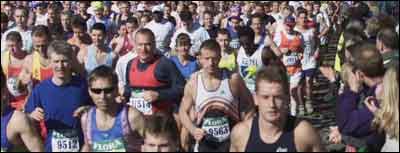
It's over! All the months of seemingly endless training runs culminated in a cool, wet day in London . On the Friday before the marathon, the nerves started to build, by Saturday night I felt an equal measure of nerves and excitement.
Matthew Pinsent's team had invited me onto their coach to reach the start at Blackheath, there was a great camaraderie on board with the Olympic gold medallist jollying everyone along. He was predicting a sub four hour time, which was hugely impressive for a first time runner, especially given his size. Although I had declared that my aim was to get round in less than five hours, I was really hoping for just under four and a half.
The wait before the start was interminable, smiles turned to looks of grim determination. With the rain getting heavier, the staple fashion accessory of the marathon runner came into its own, the bin liner. Then, finally, the start line and the countdown to the 26.2 miles.
"Don't go out too quickly", the words of advice from my coach John Nuttal rang in my ears as the nervous tension threatened to send me out like a cork from a champagne bottle. The first 9 miles were a breeze; my pace was slightly quicker than the usual ten minute mile of the longer training runs, but nothing to make me worry that I had gone out too quickly. At the halfway stage my watch showed 2 hours 7 minutes, perfect.
Then a surprising and worrying development, my quadriceps started to feel heavy, something I had never experienced in training. As I reached the 16 mile marker I was worried, the leaden feeling intensified. By 18 miles I seriously doubted my ability to finish. It got worse, at just over 20 miles I had a searing pain in my left knee. This intensified until I had to break my rule and walk. The frustration and disappointment was overwhelming, I wanted to cry. The last long run of 18 miles just three weeks ago had felt fantastic, how could this be so different?
The humiliation continued as I was overtaken by a rhino, two pink apples and a pint of beer. With a mixture of striding and short jog steps, I crossed the finish line in 5 hours and 7 minutes. I felt devastated. With a couple of loo breaks along the way and two stops for stretching, the actual time to cover the 26.2 miles was under the five hour mark, but that time on the clock will haunt me. Matthew incidentally came in at 4.08, and he was disappointed!
The crowd were incredible, it was a foul day to hang around the streets of London , but that didn't deter the spectators. The determination of the runners was inspiring, although there was tremendous support, I found it an isolating experience. As the miles passed and again at the finish line I muttered "never, ever again." Now? Well I just know I could improve on the finish time, but I think I will have to be content with been there, done that, got the medal.
April 2006
This is the time I have been looking forward to ever since I embarked on the training, the taper. When I first met coach John Nuttal at Loughborough, he explained how the sessions would build until three to two weeks before the marathon, when it would taper off. This allows the body to recover from the longer sessions and feel refreshed for the big one - 26.2 miles.
In my last diary I wrote about my ankle pain. A visit to Roné at Loughborough has thankfully sorted them out, almost. I can honestly say that the physiotherapy she carried out was one of the most painful experiences of my life. It seems as though I had (still have to a lesser degree) a case of Plantar Fasciitis, an inflammation of the connective tissue at the bottom of the foot. The cause is a combination of increased mileage and over-pronation - a tendency to roll inwards on the foot when running. This has resulted in a gradual pain building up on the inside of my ankle. Roné carried out some deep tissue massage on the arch of my foot and then tackled my calf muscles and shins. I hadn't thought there was a problem with the last two areas, but a good pummelling revealed otherwise. To reduce the swelling, I then had to sit with both feet in an ice bucket for ten minutes, if you think that sounds horrible then you would be right.
I was packed off with the instruction to continue with the ice baths twice a day and massage the arch of my feet by standing on a golf ball, rolling it up and down for a few minutes. Although neither of these was pleasant, they did seem to work. For a few days after the physio' my feet and shins were quite sore, but following the advice not to run for a few days, they started to feel normal again. All this meant I had missed out on the big training run for the week. I had planned to do 18 miles the day I went to Loughborough, but in retrospect it was just as well that I had the treatment instead.
A week later I was ready for the 18. On a bright but cool day, I plotted my route by the canal using a website to calculate the mileage. This was probably going to be my last long run before marathon day, so I wanted to stick to the same food and drink that would be available on April 23 rd . With an isotonic drink on board and plenty of water, I headed off. Like all previous long runs I listened to the radio, which really helped to break the monotony and take my mind off any pain from the ankles. I reached the halfway mark in exactly the time I had predicted, one and a half hours - and it felt fantastic. The euphoria at completing the run was tremendous; the months of training really seemed to have paid off. I won't pretend I wasn't tired or stiff the next day, but it had given me a huge psychological boost.
It was very tempting to squeeze in one last long run of 22 miles, so I could have broken through the 20 mile barrier. But all the advice was to taper off and just stick to a few short runs, which sounds good to me.
March 2006
The months have shrunk to weeks; the London Marathon now looks very real indeed. The skiing trip passed off with no major incidents, it was only a five day break but it came at an important stage of the training, just as the mileage was starting to build. While I can't honestly say that any stage of the training has been easy, I do have more confidence in my ability to complete the course on April 23rd.
The plan from my coach John Nuttall at UK Athletics has been to increase the long runs each week, so that I get to around 18 miles two weeks before the big day. I ran 15 miles on budget day (staying on my feet three times as long as Gordon Brown), alongside the Grand Union Canal . It was so refreshing to have a change of scene, the roads and footpaths near my house were starting to become very familiar and rather dull. Whether it was the new surroundings or a particular rhythm that I managed to find, a strange thing happened - I actually enjoyed it.
There is one area of concern though, my right knee has started to give the odd twinge and at the end of the long runs, both my inner ankles are sore. Today was supposed to be the 18 miler, but John has suggested I pay a visit to the excellent Roné (physiotherapist at the English Institute of Sport), to have my ankles looked at. It is very frustrating. The training has been an increasingly dominant part of my life over the past few months, with the whole week structured around the training, everything else has to just fit in.
If like me you are a first timer, you may have been following the progress of the fellow sufferers in 'Run For Glory' on Thursday evenings, BBC 1. I have been amazed, ashamed and inspired in equal measures at the determination of the would-be marathoners. The coaching tactics of Steve Cram and Sally Gunnell make me very grateful to have the mild mannered Nuttall on my side.
We probably embarked on training around the same time, with six months to build towards Marathon day. Without wishing to be cruel, I had a huge advantage in not being overweight at the start of the process. As the programme shows, so much of the secret to success is in the mind. The psychology of getting through the tough days and not giving up is something we have probably all battled with.
The next challenge is to devise a mental strategy to cope during the 26.2 miles. This could be as important as all those runs during the never ending winter.
February 2006
Well, I was warned. When I bounded into the marathon training four months ago, friends who had run the London marathon came up with reams of advice, but one theme remained constant; "It's exhausting." They were talking about the training, the marathon itself is another matter.
Over the past few weeks I've been having serious doubts, not only about my sanity, but also about my ability to complete the course. The weather certainly hasn't helped; the cold grey days don't inspire you to pull on the lycra and bound through the door. There was one ' Eureka ' run, after about 45 minutes of the usual huffing and puffing, it suddenly started to come together. My legs felt strong, the back was straight and my arms were moving in fluid motion. "By George she's got it." I was so elated that I even managed a sprint at the end. It didn't last, on my next run two days later I felt as though I had weights tied to my ankles and the road had turned to a pool of treacle.
The tiredness just wouldn't go away. Each run was an effort, I would rather stick pins in my eyes than put myself through the frustration of a run. It felt as though I had gone backwards, with each run feeling as it did back in October. A trip to the doctor revealed that I was probably low in iron, a relatively common problem for runners. Thankfully a week after taking the tablets I feel much better. It was also encouraging to talk to professional athletes based at the UK Athletics training base in Loughborough. The peaks and troughs of training are well known to every athlete and those like me who are undertaking more intensive exercise than normal.
My training schedule for the next few weeks is centred on increasing the longer runs. 'Time on the feet' is the mantra from my coach, John Nuttall. So each week I have to increase my long run by 15-20 minutes. John has always put the emphasis on time rather than distance. Having worked out that my average running pace is 6 miles an hour, I can get a rough idea of the distance I'm covering.
Some good news for all of you pounding the streets, rest and recovery is vital. According to Steve Ingham, lead physiologist at the English Institute of Sport, recovery sessions are as important as the runs. The idea is that the body needs to have time to rebuild and repair itself, which makes sense. So if you're about to head off on another seemingly endless run, comfort yourself with the knowledge that tomorrow you can enjoy an all important recovery day.
January 2006
It's cold, it's pouring with rain and, what I dread most of all, it's windy. I really don't want to go out for a run today. As I was about to make my porridge (one of the few good things about January) I checked my training schedule which is stuck onto the fridge door. Instead of 'rest' which I was hoping to see, it was '45 minutes steady run.' I have to confess that in passed weeks and months I may have swapped the rest day and stayed inside, but time is against me.
Christmas brought the usual temptations, the wrong sort of food and more booze than was probably appropriate for someone attempting to run a marathon for the first time. What made it worse was a persistent heavy cold, which most of the country seemed to be suffering from. Even walking upstairs proved difficult, let alone setting out in the freezing air for a run. I had more than a week without any training, the runners equivalent of a dieter eating a whole tub of ice cream in one go. In an attempt to reduce the guilt, I did manage a run on New Year's Day and the training is starting to get back on track.
But am I where I should be? The honest answer is I don't think I am. I really thought my fitness would have dramatically improved over the last couple of months. It's certainly true that I feel stronger when I'm out running, but the lack of stamina is still worrying me. With just 3 months to go, I am seriously doubting whether I am going to be able to complete 26.2 miles, it's such a long way!
Consulting the running books that appeared in my Christmas stocking, they all say that proper preparation is vital, particularly for first time marathoners. Although I started training back in late October, I am sure I should be fitter than I am. The training was very light in the first couple of months, so perhaps that base layer will start to pay off in the next few weeks, I do hope so.
When I was a student, I always left essays until the night before. One of the aspects I enjoy about my job is the deadline, the rush of adrenaline when a story breaks close to going on air. This is different; you can't pack months of training into a couple of weeks before a marathon. Due to my unpredictable work pattern and irregular hours, it's been really difficult to stick to the training schedule and I have skipped days. It's time to really knuckle down, no excuses, I have to stick to the schedule. It's still cold, wet and windy.
19 December 2005
It may have been painful, but the physiotherapy on my foot has worked. After some pummelling of my cuneiform bone (on the underside of the heel, as I have now discovered to my cost) I am ready to starting pounding the roads once again.
My coach John Nuttall at UK Athletics has sent me a new training programme. He broke me in gently back in October, but now the serious stuff is starting. The week begins with 30 minutes steady run followed by drills, varying pace and sprinting. Tuesday is an easy day, just 20 minutes. That prepares me for Wednesday, 20 minutes hard which is 90% of my maximum capacity. This is still something that I am finding difficult to gauge, but presumably will improve with a number of these lung bursting sessions. Thursday, rest. Friday is a bike day, 40 minutes, which for me means static in the gym as I haven't owned a bike since I was a teenager. Saturday brings a 50 minutes steady run and Sunday, thankfully, is a day of rest.
The programme lasts 4 weeks, but each week the sessions build in duration and intensity. The steady runs on a Saturday increase to 60 and then 75 minutes. This doesn't concern me too greatly; I have already put in a run of over an hour. Admittedly at times it was little more than a plod, but I was quite pleased with my stamina at the end, where I managed a sprint. Although that could have been the thought of a hot shower!
My main concern at the moment is the time that's needed to dedicate to the training programme. My work commitments mean I spend a lot of time travelling from home in Warwickshire to London or Manchester . Fitting in even a 20 minute run can be problematic, the whole session always seems to take about twice as long once stretches, showering and changing are taken into account.
A friend who has run the London Marathon, starting from a similar level of fitness has given me some encouraging and useful advice. "Don't think of it as training for 26.2 miles, break it down into manageable chunks over the months, 10 K, then a half marathon in February." As I look at the training schedule for the four weeks with these words in mind, it does seem more manageable. My fitness is certainly building, but fitting in all these sessions is my latest challenge. That and trying to make sure that all the hard work isn't undone by the mince pie and sherry season.
17 November 2005
A few days by the sea, fresh air and plenty of opportunity to put in some training miles. I was really looking forward to spending some time in Devon. It didn't quite work out as planned. After a bracing eight mile walk along the coastal path, wearing wellington boots which probably wasn't wise, I strolled back along the beach with the dog. She stopped by a stick which was far too big to throw, I stamped on it with the edge of my right foot to break it in half. I thought nothing of it at the time. Later that day I set off on a four mile run along the sea front, feeling invigorated by the sea air. As I climbed into a much needed hot shower, my right foot felt rather sore. A pain developed on the outside edge and spread underneath, it hurt when I put weight on it.
The next day I could hardly walk. The mantra of Roné, the physiotherapist at the English Institute of sport, came back to me. "If you get an injury, remember RICE," she had told me. This stands for rest, ice, compression and elevation. So I duly sat with a bag of ice on my raised foot for most of the day. Unfortunately the pain persisted, so when I returned home I went to see my GP. He thought it was nothing more sinister that a severe bruising to the metatarsal, a bone in the foot. He repeated the advice about ice and advised against any weight bearing exercise for at least a week. This was a real blow to my training plan. I had just received my latest schedule from coach John Nuttall at Loughborough University. It's a mixture of running and cross training, e.g cycling. All I could do was pull on my goggles and attempt to keep up some sort of fitness in the pool.
I am due to see John and the team at Loughborough in the last week of November, for a VO2 Max test. This will assess how fit I am by measuring my lung capacity as I pound the treadmill. As I haven't done any running for ten days and my foot is still painful, this will probably have to wait. I am seriously worried about the time my foot is taking to recover. I know I still have a long way to go before I am in the kind of shape to run be able to run even a half marathon, let alone more than 26 miles. Every day is precious.
There have been some beautiful, cold, crisp days in the past week. I never thought I would be envious of people running, but seeing others out pounding the streets as I continue to hobble is really frustrating. I think it's time for a return visit to my GP and a call to the team at Loughborough.
Wednesday 25 October 2005
"I'm thinking of running the London Marathon next year." I thought if I said it out loud, I might be able to convince myself it would be a good idea. Little did I know that these words would be pounced upon by Gavin, Deputy Editor of Today. "Excellent" he said, rather too enthusiastically for my liking, "you can do an audio diary and chart your progress, we'll get you monitored along the way, what sort of time are you aiming for?" Gavin clearly had a warped idea of my athletic ability.
Like most prospective London Marathon runners, although I try to exercise regularly, I certainly can't claim to be a runner. The last time I competed in a race was cross country at school, and I seem to remember I didn't cover myself in glory. So why am I doing it? It might sound a bit lame, but it's a challenge. I have spoken to several friends who have taken part in and completed the London Marathon, they all said the same, "do it, but make sure you train properly."
There are plenty of books dedicated to the subject of training for a marathon, but there is also conflicting advice, I felt I needed a one to one approach. UK Athletics have agreed to provide training and support, so I will be using their facilities at Loughborough University . I arrived for my assessment with a sense of anticipation, but also a good deal of nervousness. Everywhere I looked there were supremely athletic looking bodies striding confidently around, what was I doing there?
John Nuttall is former Commonwealth 5000m bronze medallist and has competed in the Olympics and World Championships, he's now an endurance coach with UK Athletics. He has the not inconsiderable task of turning me from a rather sedentary presenter to a runner capable of completing 26.2 miles next April. On first meeting John seems amiable and inspiring. He tells me that I will be assessed by a physiotherapist and be given a medical, both advisable if not essential if you haven't undertaken any distance running. As he starts to gather some background information on my previous athletic achievements (none), we both realise the scale of the challenge ahead. Encouragingly, he sees no reason why I shouldn't be able to compete in and complete the London Marathon. But, he warns, there is plenty of work to do. Over the next six months I will be given strength and conditioning training, sports massage and nutritional advice.
Roné Thompson is a physiotherapist with English Institute of Sport. She casts her eye over my posture and by simply watching me squat down on one leg, determines that I have a weakness in my left hip. After being filmed running on a treadmill, Roné tells me that I need to work on building up the strength in my hips and buttocks to prevent injury to knees, shins and ankles. The series of exercises that she takes me through are quite painful, but I will have to do these twice a day to build up the necessary strength to cope with the miles. As I stand like a flamingo against a wall, the pain starting to well up in my left hip, I keep focusing on the buttocks of steel I will have in six months!
Dr Nick Pierce is used to dealing with athletes at the English Institute of Sport, but he agreed to give me the once over to make sure I wasn't in danger of collapsing during my training. He was keen to point out the benefits of running, but also the risks. Anyone who hasn't run regularly, or exercised recently is advised to have a medical before undertaking a marathon. Due to the history of heart disease in my family, Nick took the precaution of carrying out an ECG. After taking my blood pressure and pulse, listening to my heart and lungs, he pronounced me fit to start training.
My first session with John Nuttall is in mid November. In preparation, he has told me to run for 15 -20 minutes three times a week. That, I can manage. What is concerning me more is the stamina test that awaits me in November, running to the point of collapse. Do not try that at home.
 Back to Reports Homepage Back to Reports Homepage
| | | | |
| | |