 |  | |
 Arts Correspondent, Rebecca Jones. Arts Correspondent, Rebecca Jones.
In July 1954 a trial in Lincoln had a major impact on the popular and lucrative market of the 'saucy seaside' postcard. The main artist to fall foul of the crackdown was Donald McGill.
Hailed by the magazine 'Punch' as 'the most popular, hence most eminent English painter of the century'. Donald McGill's postcards came under the scrutiny of the Conservative government who returned to power in 1951.
They decided to crack down on the declining morals which they believedhad set in during the Second World War. Committees were soon set up to judge taste and decency of artwork and literature. It was during this period that 167,000 books were censored.
Soon attention was focused onto the British 'saucy seaside' postcards. Every resort from Blackpool to Bournemouth, and Margate to Cleethorpes had its own 'Watch Committee' which ruled which cards were allowed to be sold to the public. Local busy bodies were regularly reporting 'obscene' cards to these local censorship committees.
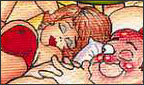
The main target was the artist Donald McGill, known as the 'The King of the Saucy Postcard'. Between 1904-1962 McGill produced an estimated 12,000 designs of which an estimated 200 million were printed and sold.
Police raids resulted in the arrest and prosecution of both publishers and artists. To co-incide with this anniversary, the cartoon art trust are holding an exhibition to celebrate the trials and tribulations of Donald McGill's work. Our arts correspondent, Rececca Jones went along to the exhibition to meet the curator, Anita O'Brien, and Patrick Tumber, Donald McGill's grandson.
THE TRIAL
There were several local trials - culminating in a major trial held in Lincoln on 15 July 1954. The charge was breaking the 1857 Obscene Publications Act.
McGill's lawyers mounted a defence that posed the question: 'are the cards capable of corrupting the minds and morals into the hands they come'? McGill himself wrote a letter to his lawyers which put forward his argument... "
I have carefully considered the cards complained of… and I set forth my observations in respect of each card with explanations to show my mental approach.. I would desire to point out that in quite a number of cards in question I had no intention of 'double meaning' and, in fact, a 'double meaning' was in some cases later pointed out to me..."
McGill was eventually found guilty and the punishment was a £50 fine he had to pay £25 costs. Apart from the financial burden to McGill, the result had a devastating consequence on the saucy postcard industry. Many postcards were subsequently destroyed and retailers cancelled their orders. Postcard companies survived on very small margins and several of the smaller companies were made bankrupt.
RETURN OF THE SAUCY POSTCARD
In the late 1950's the level of censorship eased off In 1957 McGill gave evidence before the House Select Committee in order to amend the 1857 Act. He felt a national system of censorship would be open to the vagaries of individual interpretation.
Documents are on permanent loan from the Crown Prosecution Service to the Centre of the Study of Cartoons and Caricatures, University of Kent, Canterbury - courtesy of the collection of The Centre for the Study of Cartoons and Caricature at the University of Kent at Canterbury.
All images are copyright of the Cartoon Art Trust.
 Back to Reports Homepage Back to Reports Homepage
| | | | |
| | | | | |
 | |
| |
|