|  |
| |  | | My Day On Hedgehog Island
by Huw Williams on South Uist, Outer Hebrides | | | | I suppose I always knew it was going to be an odd assignment. But I wasn’t until I leaned in through the window of a car parked outside a store in Creagorry that I realised just how odd.
The crofter I wanted to interview looked at me with a totally straight face. “Have they thought about condoms for the hedgehogs?”, he asked, apparently absolutely seriously. Then his face cracked into an enormous grin.
But, bizarrely, the subject of contraception for hedgehogs had already come up a couple of times, since I arrived on South Uist in pursuit of the spiny creatures.
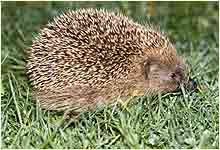
The very first ones were - allegedly - brought to the Western Isles (or outer Hebrides, take your pick which name you prefer) in 1974. Some-one - and, perhaps fortunately, history doesn’t record who - is supposed to have thought they’d be perfect, for keeping down the slugs and snails in their garden.
At first the experiment seemed to be working. It seemed such a good idea, in fact, that the same person went back to the mainland a year later, to collect three more hedgehogs.
In the nearly thirty years since then, however, nature has taken its course. There are now at least five thousand hedgehogs in South Uist, the neighbouring island of Benbecula, and into North Uist. One woman even told me she thought the real population might be twenty or thirty thousand.
The fact that all the islands are now linked by causeways has helped them thrive. So has the fact that, because there were never supposed to be hedgehogs on the islands, there are no predators to control their numbers.
You’re thinking , interesting, but where’s the problem?. Well, the Uists are also home to some internationally important populations of ground nesting birds - snipe, dunlin, and ringed plover to name just three. And over the same period, their numbers have declined, by as much as sixty per cent for some species.
The government agency, Scottish Natural Heritage, says there’s no doubt the hedgehogs are responsible. As well as slugs and snails, they also eat eggs, and will even kill young chicks on the nest. More Hannibal Lector, than Mrs Tiggeywinkle.
So, just about everyone agrees something has to be done. The experts at SNH say there should be a cull, to exterminate the hedgehogs. All of them. But that’s provoked a co-ordinated international campaign, saying that the ’hogs should be live-trapped, and re-located to the mainland. Transportation not execution, if you like.
The bad publicity forced the board of SNH to delay a decision, so they could consult more widely with animal welfare groups, and the pro-hedgehog campaigners, on alternatives to the cull.
And that’s why I ended up talking hedgehog condoms with a crofter. (Wouldn’t their prickles burst them?) And, that’s why I also found myself having a serious conversation with one conservationist about how difficult it is to sterilise hedgehogs. And asking another expert in the field whether it would be possible to feed them oral contraceptives (in case you’re wondering, the answer - apparently - is no.)
Until that changes … and wouldn’t it be exciting to find that there is a scientist out there some-where developing the pill for hedgehogs … five thousand breeding adults can produce ten thousand young every year. And - at least at the moment - they’re being born into hedgehog heaven.
Pro-hedgehog groups say anyone who kills the animals could be breaking wild-life law. People who support the cull counter that by pointing out that European law makes Scotland legally responsible for protecting the bird populations … and warn there could be legal action if something isn’t done soon to stem the declining numbers.
So, it’s a bit of a mess. A bit like the tourists in the Highlands (or Ireland, or west Wales - chose your own stereotype) who stopped to ask an old man by the road-side how to get to the little village where they were booked into a B and B. “Ah”, he said, “if I were you, I wouldn’t start from here.” The trouble is, we are where we are. Humans put hedgehogs into the Western Isles. So, it’s up to us to sort out what we’ve done. And if we want the birds of the Uists to survive, experts say, we can’t leave the hedgehogs there too.
LINKS
Read the Hedgehog emails
Read the Hedgehog report
Lionel Kellaway investigates the bizarre ritual of hedgehog courtship
British Hedgehog Preservation Society
Hedgehogs on Radio 4's The Living World
Please Note:
The BBC is not responsible for the content of external websites.
| | | | | | |
|
| |