| | | | | | | | | |

| | | WILD AWAKENING
|  | |  | MISSED A PROGRAMME?
Go to the Listen Again page | | | | | | | | |
| |
Howard Stableford travels to Ohio to see and hear a natural phenomenon that only occurs every 17 years
| | | 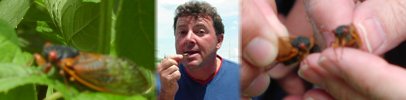 | | Howard Stableford finds out whether if you can't beat cicadas,
you can eat them... |  |  Listen again to the programme Listen again to the programme | |
Wild Awakening
Howard Stableford travels to Cincinnati in Ohio to observe a natural event that sounds like the plot of a 1950s B movie.
Once every 17 years, billions of bugs called periodical cicadas emerge from the soil under the cover of darkness before engaging in a massive and very noisy mating frenzy that's hard to ignore.
After spending years underground sucking on tree roots, countless insect invaders cover the trees and begin their mating calls using structures on the sides of their bodies called tymbals.
With up to 1.5 million insects per acre, each capable of calls louder than 100 decibels, the chorus is deafening.
Howard meets Gene Kritsky who studies these noisy creatures to learn more about their unusual lifestyles.
The cicadas emerge in such huge numbers so there are plenty left to mate even after their predators have had their fill.
Howard also discovers how the local residents cope with the insect invasion.
As the cacophony starts, many people pack up and leave the city for the weeks the cicadas are in town.
But to others they are a source of inspiration - Howard meets musicians who have written songs about the event and tastes some local delicacies; stir-fried and chocolate-covered cicadas!
| | |
RELATED LINKS | | | Cicada Watch: 2004
The BBC is not responsible for the content of external websites
| | |
| | |
|