| | | | | | | | | |

| | | THE MATERIAL WORLD
|  | |  | MISSED A PROGRAMME?
Go to the Listen Again page | | | | | | | PROGRAMME INFO | | | |
| | | Quentin Cooper reports on developments across the sciences. Each week scientists describe their work, conveying the excitement they feel for their research projects.
| | | | | | Contact Material World | | | | | LISTEN AGAIN 30 min 30 min | | | |
|
|
|  | PRESENTER | | | |
| 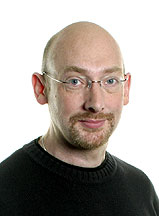 | | | | "For me science isn't a subject, it's a perspective. There are fascinating scientific aspects to everything from ancient history to the latest gadgets, outer space to interior decorating; and each week on The Material World we try to reflect the excitement, ideas, uncertainties, collisions and collaborations as science continues its never-ending voyage into the unknown".
Quentin Cooper | | | |
| | | | | | PROGRAMME DETAILS | | | |
|  | | |
Power Harvesting
Imagine if you could harness the power of the 34,000 commuters who pass through London's Victoria station in rush hour. These people could be generating enough energy to provide the power for 25 households for one day.
Wherever there's a vibration, be it from commuters' footsteps, a wobbly bridge or walking from your desk to the photocopier, you could use a free energy harvesting device to provide light, charge your mobile phone or even supply power to the national grid.
To find out how to capture this untapped energy source Quentin Cooper meets Claire Price, director of London architects The Facility, and Dr Jim Gilbert, Professor of Engineering at Hull University.
Over the last six months Jim has been working with Claire's practice to developing a flooring system that will harvest energy 'wasted' into the ground from people's footsteps.
Moonwatch
Moonwatch is a scientific experiment which aims to get as many people as possible to record when they first see the new crescent moon.
On Saturday, 27th May, an exceptionally young crescent moon is going to be visible - it will only be about 15 hours old.
The experiment is being coordinated by Her Majesty's Nautical Almanac Office, based at the Rutherford Laboratories.
Dr Usama Hasan, a member of the Muslim Council of Britain and a keen amateur astronomer, tells Quentin about the importance of the moon to the Islamic calendar, and how Moonwatch will help predict Muslim festivals accurately.
He's joined by Dr Robert Massey, an astronomer based at the National Maritime Museum in Greenwich and co-deviser of the experiment. | | |
RELATED LINKS
The Facility
University of Hull: Dr Jim Gilbert
Moonwatch
Her Majesty's Nautical Almanac Office
Greenwich Royal Observatory
Muslim Council of Britain
BBC Radio 4 Science Programmes
BBC Science & Nature
The BBC is not responsible for the content of external websites
| |
| | |
|