| | | | | | | | | |

| | | THE MATERIAL WORLD
|  | |  | MISSED A PROGRAMME?
Go to the Listen Again page | | | | | | | PROGRAMME INFO | | | |
| | | Quentin Cooper reports on developments across the sciences. Each week scientists describe their work, conveying the excitement they feel for their research projects.
| | | | | | Contact Material World | | | | | LISTEN AGAIN 30 min 30 min | | | |
|
|
|  | PRESENTER | | | |
| 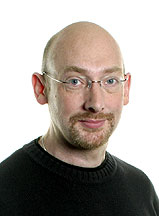 | | | | "For me science isn't a subject, it's a perspective. There are fascinating scientific aspects to everything from ancient history to the latest gadgets, outer space to interior decorating; and each week on The Material World we try to reflect the excitement, ideas, uncertainties, collisions and collaborations as science continues its never-ending voyage into the unknown".
Quentin Cooper | | | |
| | | | | | PROGRAMME DETAILS | | | |
| 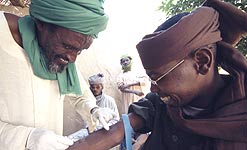 | | Taking blood samples in Chad
Picture by David Evans © |
Mankind's genetic origins
Where do we actually come from? That is the question that the National Geographic Genographic Project has been trying to answer. By collecting DNA samples from people all over the world, the project is trying to unlock the secrets to humankind's ancestral past.
To explain how genetic differences can tell us about how humanity spread around the globe, Quentin Cooper is joined by Spencer Wells, director of the Genographic project, and Mark Thomas from the Centre for Genetic Anthropology at University College London.
Space Junk
Nearly 50 years ago the first artificial satellite, Sputnik I, was launched into space. Since then the thousands of objects that have followed in Sputnik's path have created a blanket of rubbish that orbits the Earth. Space debris, travelling at 25,000 miles per hour, is a real threat to space craft and active satellites - a collision could have devastating consequences.
Dr Emma Taylor from The Open University, who recreates 'hypervelocity impacts' in the lab, and Dr Stuart Eves, Principal Engineer with Surrey Satellite Technology Ltd, will join Quentin Cooper to talk about how what goes up doesn't always come down.
| | |
RELATED LINKS
Genographic Project
Centre for Genetic Anthropology
CEPSAR
Open University Physics and Astronomy
Surrey Satellite Technology
Space Junk
BBC Radio 4 Science Programmes
BBC Science & Nature
The BBC is not responsible for the content of external websites
| |
| | |
|