| | | | | | | | | |

| | | THE MATERIAL WORLD
|  | |  | MISSED A PROGRAMME?
Go to the Listen Again page | | | | | | | PROGRAMME INFO | | | |
| | | Quentin Cooper reports on developments across the sciences. Each week scientists describe their work, conveying the excitement they feel for their research projects.
material.world@bbc.co.uk | | | | | LISTEN AGAIN 30 min 30 min | | | |
|
|
| | PRESENTER | | | |
|  | | | | "For me science isn't a subject, it's a perspective. There are fascinating scientific aspects to everything from ancient history to the latest gadgets, outer space to interior decorating; and each week on The Material World we try to reflect the excitement, ideas, uncertainties, collisions and collaborations as science continues its never-ending voyage into the unknown".
Quentin Cooper | | | | BIOGRAPHY
INTERVIEW |
| | | | | | PROGRAMME DETAILS | | | |
| 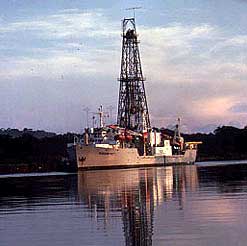 | | | Joides Resolution courtesy of Ocean Drilling Programme |
Ocean Drilling
Before HMS Challenger set out in 1872, no one even knew how deep the oceans were.
They did not know about the continental margins that have since proved so important for their reserves of oil and natural gas, the mineral wealth of the deep sea, nor the strange creatures that dwell there.
Nor were they aware of the longest mountain chain on Earth, the 70,000 km long mid-ocean ridge system that was to provide crucial evidence in understanding sea floor spreading and continental drift almost a century later.
But by the end of 1876, when Challenger's 100,000 km journey reached its end, the new science of oceanography had been born.
But even today, we know little more about the sea than we do about the Moon. As international scientists begin their new ‘Integrated Ocean Drilling Programme’, Quentin Cooper explores some of the outstanding mysteries of the deep by talking to Dr Richard Corfield, Department of Earth Sciences, Oxford University and author of ‘The Silent Landscape’ and Dr Kate Royse of the British Geological Survey and UK Programme Manager for the Integrated Ocean Drilling Programme.
Skin Permeability
The skin is an amazing organ – the biggest and most accessible in our body.
It forms an impermeable layer, or barrier, preventing many substances getting in and out.
Have you ever thought why suncreams feel so oily? It’s so the cream stays on the surface and doesn’t get absorbed.
But some molecules do make it through the barrier – nicotine and nitro-glycerine are just two. This can be used to our advantage as medicines can now be administered through our skin.
Not all substances are so welcome though. Some unwanted toxins can get through the barrier.
Professor Jonathan Hadgraft a skin chemist from the University of Greenwich and Dr Mike Cork, a dermatologist at the University of Sheffield Medical School join Quentin to get ‘under the skin’.
Next month: We are recording a special programme in which you can put your questions directly to Quentin Cooper and a panel of experts.
If you'd like to ask a question, you can do so by sending an email to material.world@bbc.co.uk If you'd like to ask your question in person, please include a daytime telephone number. | | |
RELATED LINKS
BBCi Science
Kate Royse
Integrated Ocean Drilling Programme
The 'Old Ocean Drilling Programme'
Richard Corfield
Mike Cork
Skin Permeability
Micro Needles
Berkeley Engineering
BBCi Skin
BBC News Babies & Eczema
The BBC is not responsible for the content of external websites
| |
| | |
|