| | | | | | | | | |

| | | SINGLE WHITE RHINO... WOULD LIKE TO MEET
|  | |  | MISSED A PROGRAMME?
Go to the Listen Again page | | | | | Headline | | | |
| |
Rosamund Kidman-Cox presents a two-part series that explores the captive breeding programmes of endangered species in zoos and wildlife parks; and asks how it aids conservation of the animals in the wild and the survival of endangered species.
| | | 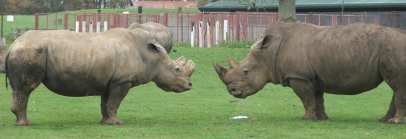 | | | Trio and Nsiswa - at Whipsnade Wild Animal Park |
You can download this programme as an MP3
Today zoos and wildlife parks are reservoirs of some of the most endangered animals in the world – and some of those are the most difficult to breed in captivity.
From the prehistoric looking five rhino species to the smallest of exotic tropical snails, the minute detail of their breeding behaviour has to be understood and ideal conditions created for a successful mating to produce eventual offspring.
As with any dating, it is a case of finding suitable partners, ensuring the first meeting goes well and hopefully leads to a successful breeding attempt as the only thing required to ensure a future for the species is the production of offspring.
Within breeding programmes this is all managed through studbooks and vast databases holding all the crucial genetic information and history of the individual animals.
The southern white rhino found in Africa was the first of the 5 worldwide rhino species to face extinction when numbers dropped to less than 200 animals at the turn of the 20th century but with protection and in situ (where they live) and ex situ (in zoos) captive breeding, the species has recovered and numbers about 11,500 animals today so why is there a need to still breed southern white rhinos in captivity in zoos?
Zoos often hold more of the critically endangered species in captivity than actually exist in the wild today but some of these animals will never be returned to the wild – so why doesn’t that happen and what’s the point of captive breeding if population numbers in the wild are not boosted from this reservoir of animals?
The zoos use some of these captively held species as ambassador or flagship species - trying to raise awareness of their plight in the wild and by encouraging zoo visitors to support conservation projects.
European legislation now requires zoos in Europe to demonstrate a conservation emphasis in their work and through national and worldwide zoo assocations, members of those assocations are also now being encouraged and evaluated on the amount of conservation work they do.
Conservation education about the threats to these endangered species is an important part of this as millions of people visit zoos worldwide.
Programme 1: Friday 23rd February at 11:00
 Listen again to this edition Listen again to this edition | |  | | |
Programme 2: Friday 2nd March 2007 at 11:00
Listen again to this edition | | |
RELATED LINKS | | | Bristol Zoo's partula snail breeding programme
Information about the White Rhinoceros
The Durrell Institute of Conservation and Ecology
Carl Jones's work on Mauritius
An example of successful conservation education
The RSPB Cirl Bunting Reintroduction Project
The work of the John Aspinall Foundation
A Different Nature: The Paradoxical World of Zoos and Their Uncertain Futureby David Hancocks
The British and Irish Association of Zoos and Aquariums
The World Association of Zoos and Aquariums
The Zoological Society of London
BBC Science & Nature
The BBC is not responsible for the content of external websites
| | |
| | |
|