| | | | | | | | | |

| | | SHADOWS ON THE LANDSCAPE
|  | |  | MISSED A PROGRAMME?
Go to the Listen Again page | | | | | In this five part series, Dylan Winter traces the history of some of the animals that once lived amongst us and that are now making a return | | | |
| |
Dylan Winter travels the country to sense and trace the animals that once lived amongst us but were persecuted or hunted to extinction in the last few hundred years. He meets those who work towards their return so we can once again experience a life with them, rather than just the shadow of their presence, left like an echo on the landscape.
| | | 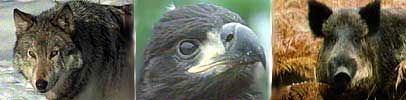 | | | The wolf, white-tailed sea eagle and a wild boar. |
Programme 1 - The White-tailed Sea Eagle
Having gone extinct in Britain in 1918 due to human persecution, the white-tailed sea eagle was successfully reintroduced to Scotland, on the isle of Rum, in 1975. This enormous bird which is the world's fourth largest eagle has a wingspan of 8 foot which has led to them being described as "flying barn doors". Dylan travels to the island of Mull where one of the most successful breeding populations of sea eagles exists today. With 26 chicks fledged in Scotland last year and another 18 this year, it seems like the bird's future in this country is assured.
RSPB White-tailed Sea Eagle diary
 Listen again to Programme 1 Listen again to Programme 1 | |  | | |
Programme 2 - The Beaver
The beaver is Europe's largest native rodent and is thought to have been extinct in Britain for the last 400 years. Having been reintroduced to many other European countries, in the late 1990's a consultation process began in Scotland to look at their possible reintroduction. Dylan Winter travels to Devon to meet someone very keen to see the beaver back and asks whether it is too late for the European beaver to ever return to our wetlands.
Species Profile: The European Beaver
Listen again to Programme 2 | | | | |
Programme 3 - The Wildwood and the Wolf
In the Borders of Scotland there is a vision to restore a recently purchased valley to be an ancient wildwood once again. Britain was once covered in these vast tracts of forest that stretched up the country for miles. Today pockets of ancient Caledonian forest still exist but there is little else. The Wildwood was home to the wolf and ancient cattle called aurochs. The last wolf in Scotland was killed in the mid 1700s and while some may relish its return to our landscape it is unlikely the wolf, with its association in people's minds as a fearsome predator, will ever be seen again living wild in this country.
Find out more about the Carrifran Valley
Listen again to Programme 3 | | | | |
Programme 4 - The Wild Boar
After an absence of 300 years, with no help from a carefully managed reintroduction programme, the wild boar is recolonising our woods after escaping from wild boar farms and abattoirs. A healthy population now exists in the woods of Kent and East Sussex. But as their numbers slowly and naturally increase, concerns are now being expressed about whether their numbers should be managed.
Find out more about the Wild Boar in Britain
Listen again to Programme 4 | | | | |
Programme 5 - The Great Bustard
This huge bird, related to the crane family, is the county bird of Wiltshire and as of this month is once again strutting on the chalk grasslands of Salisbury Plain. The great bustard has not nested here since 1832. It was formerly widespread across England and even bred in south east Scotland in the 16th century. In England it was found on the plains and wolds of Dorset, Wiltshire, Hampshire and Sussex. Earlier this year, the Great Bustard Group, headed up by David Waters, successfully reared abandoned eggs of great bustards in Russia and transported the young chicks to Wiltshire. After a period of quarantine and acclimatisation to their new surroundings, the first great bustards to be seen here for almost 200 years were released from their holding pens to start a new life on their former home ground.
The Great Bustard Group
Listen again to Programme 5 | | |
RELATED LINKS | | | West Runton Elephant(Norfolk Museums & Archaeology Service)
The Taung Child(Natural History Museum)
The BBC is not responsible for the content of external websites
| | |
| | |
|