| | | | | | | | | |

| | | SAY WHAT YOU THINK
|  | |  | MISSED A PROGRAMME?
Go to the Listen Again page | | | | | Practising neuroscientist and monoglot Dr Mark Lythgoe grapples with the science of learning languages | | | |
| |
Language not only shapes our culture, but it also shapes our brain, body and behaviour. New research suggests that being bilingual could increase your problem solving skills and delay cognitive decline as we get older. This two-part series looks into the science of learning languages. How does language change our brains? And why is it so much harder to learn a language as an adult rather than a child?
| | | 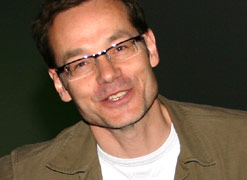 | | |
Working as a neuroscientist at University College London presenter Dr Mark Lythgoe (pictured) is very aware of the way language influences the brain. But despite this, he's a self-confessed linguaphobe. "Learning languages is my idea of an absolute nightmare," says Lythgoe. "I just don't feel like I have the right sort of brain to take it on."
During the series, Mark attempts to learn Spanish using a variety of conventional, and more unusual, techniques. Along the way he explores new research on the science behind learning language.
Programme 1
Why is learning a language so much harder for adults rather than children?
Mark travels to the baby lab at the University of Barcelona to meet psychologist Laura Bosch. She's shown that even by two months old, babies can differentiate Spanish from Catalan.
However, our ability to perceive the phonetic differences in foreign language declines with age. During our childhood, our brains tune in to different parts of speech - from phonetics, to grammar and then vocabulary. But does this ability end?
Linguists disagree as to whether there is a 'critical period' when our brains are geared to acquire language. Some like Elissa Newport claim that if you learn after puberty, you will never be as good as a native. But others such as Lydia White and Ernesto Macaro say that all adults need is as much motivation and immersion in their new language as we experience as children.
Unperturbed, Mark visits the Phonetics Lab at Oxford University, where John Coleman attempts to retrain him in the art of Spanish pronunciation.
 Listen again to Programme 1 Listen again to Programme 1 | |  | | |
Programme 2
How does learning a language affect your brain?
This week Mark experiments on himself to see how our grey matter manages languages. Only now are researchers like Frederique Liegeois uncovering the complex neural networks that control language.
But language also controls us. Many researchers, from psychologists like David Green to linguists like Vivian Cook, believe that the language we speak may affect how we think. This controversial theory was first mooted by Sapir and Whorf in the early part of last century.
Whether or not language controls our thoughts and personality is debatable. But recent evidence does show that being bilingual can change our brains. Learning a new language can increase your grey matter, and could have cognitive advantages. Ellen Bialystok has shown that bilingual people are better at multitasking, possibly because they constantly exercise their prefrontal cortex.
During the programme Mark also continues on his quest to learn Spanish. He finds out why some people have a knack for languages, whilst others struggle. And he visits Barcelona for some intensive training.
Listen again to Programme 2 | | |
RELATED LINKS | | | BBC Science & Nature
BBC Learning English
BBC Languages
Programme 1
University of Barcelona - Cognitive Neuroscience Group
Carnegie Mellon University - Erik Thiessen
University of Oxford - Jean Aitchison
SEAL - Society for Affective and Effective Learning
University of Rochester - Elissa Newport
McGill University - Lydia White
University of Oxford - Phonetics Lab
Programme 2
UCL – Centre for Human Communication
Newcastle University – Vivian Cook
Oxford University – Ernesto Macaro
UCL – Bilingual Research
University of Neuchâtel – Francois Grosjean
York University, Canada – Ellen Bialystok
Don Quijote Spanish School – Language Resources
The BBC is not responsible for the content of external websites
| | |
| | |
|