| | | | | | | | | |

| | | LEADING EDGE
|  | |  | MISSED A PROGRAMME?
Go to the Listen Again page | | | | | | | PROGRAMME INFO | | | |
| | | Leading Edge brings you the latest news from the world of science. Geoff Watts celebrates discoveries as soon as they're being talked about - on the internet, in coffee rooms and bars; often before they're published in journals. And he gets to grips with not just the science, but with the controversies and conversation that surround it.
radioscience@bbc.co.uk | | | | | LISTEN AGAIN 30 min 30 min | | | |
|
|
| | PRESENTER | | | |
|  | | | | "If what interests you are new and exciting ideas, it's science you should be turning to. And whether it's the Human Genome Project or the origins of the Universe, Leading Edge is the place to hear about them."
Geoff Watts | | |
| | | | | | PROGRAMME DETAILS | | | |
|  | | ©Margaret Marchaterre
|
This week on Leading Edge - humming fish, blind hearing, ancient Olympics and synaesthesia.
The hums of horny fish
A species of humming fish found in the Pacific could inspire new treatments for hearing loss.
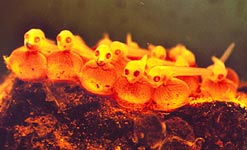
Female 'plainfin midshipman' fish become more sensitive to the males' love song during the breeding season.
Biologist Andrew Bass of Cornell University, thinks that understanding the hormones involved could help treat human hearing problems.
Ancient athletics
Drag-resistant sportswear and new improved drug testing are two technologies showcasing at this year’s Olympics in Athens.
But what was ‘the latest thing’ back in ancient Greece?
Gold medal-winning athlete Jonathan Edwards investigates the 2,000 year-old kit that kept Greek athletes at the top of their field.
Synaesthesia
If you think that the letter A is red or the number 7 is blue, then you may not be as unusual as once thought.
Synaesthesia could be 10-20 times more prevalent than estimated, according to Jamie Ward from
UCL.
Geoff joins him in the Science Museum to take part in a colourful experiment.
Blind pitch
Pascal Belin of the University of Montreal has found that people who become blind in infancy have a better sense of musical pitch than those who went blind later in life.
His findings imply that we should all revise our ideas about music teaching.
Leading Edge returns in a new series on Thursday September 2nd, 2004
| | |
RELATED LINKS
Cornell University - Andrew Bass
UCL Synaesthesia Research Group
BBC Science - Hearing and the ear
h2g2 - Guide to synaesthesia
UK Synaesthesia Association
BBC History - The Ancient Greeks
BBC Sport - Olympics 2004
BBC Science & Nature
The BBC is not responsible for the content of external websites
| |
| | |
|