| | | | | | | | | |

| |  | HOME PLANET
|  | |  | MISSED A PROGRAMME?
Go to the Listen Again page | | | | | | | PROGRAMME INFO | | | |
| | | Richard Daniel chairs the interactive environmental programme in which he and his guests deal with listener's questions and concerns.
Call 0370 010 0400
[email protected]
Home Planet, PO Box 3096, Brighton BN1 1PL | | | | | LISTEN AGAIN 30 min 30 min | | | |
|
|
| | PRESENTER | | | |
| 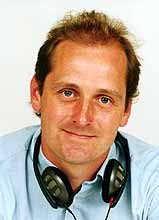 | | | | "Home Planet is the environmental programme for which you set the agenda. We tackle your questions and concerns and try and make some sense out of the conflicting opinions which make up the environmental debate."
Richard Daniel | | | | |
| | | | | | PROGRAMME DETAILS | | | |
|  | |
Panel
Dr Carolin Crawford
Dr Nick Riley
Professor Philip Stott
TOPICS
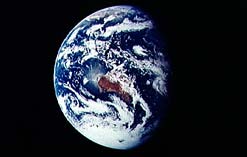
Where does space start?
Whatis.com
Discussion from archived NASA website
CNN
Can you see the Great Wall of China from Space?
BBC News
Zyra
Space.com
NASA
Given the different speeds, mass and trajectory of objects hitting the moon - why are its craters all a similar shape?
Lunar and Planetary Institute, Houston Texas
Volcano World On-line simulator
NASA
Philip Stott's experiment:
You are testing the null hypotheses that there is no difference in the basic form of craters produced by (i) different-sized peas ('meteorites'), (ii) different-shaped peas, and (iii) peas hitting the surface at different angles and speeds;
(a) Take one large, dry tea cup or bowl;
(b) Fill it to nearly full with plain flour, add very little water and mix - just sufficient water so that the flour will hold its form when turned out of the cup. The surface should still be 'dusty';
(c) Place a plate over the open end of the cup and tip it up gently so that a 'moon hemisphere' is positioned on the plate;
(d) Gently compact and make smooth the surface;
(e) Select a range of frozen peas of different sizes and shapes;
(f) Take one pea (Pea A). Note its size, shape, and weight, and then aim it at the 'moon's surface': (i) at different angles (including skimming the surface) and (ii) at different speeds;
(g) Record the shapes, sizes, and depths of each crater produced by Pea A;
(h) Smooth the surface again, and repeat for peas (B), (C,) etc., of different sizes and shapes;
(i) With the last pea (X), don't smooth the surface before using it so that you can look at the impact of a craters formed on craters;
(j) Now, compare and contrast all your results and assess the degree to which the null hypotheses must be replaced by alternative hypotheses.
Impact craters on earth
Solarviews
Geo-Thermal Energy
Southampton City Council
BBC Weather
Towards Sustainability has a list of on-line resources
Loss of earth's hydrogen into outer space
WebElements
Los Alamos National Laboratory
California Institute of Technology
BrightSurf
European Geosciences Union
Pluto
International Astronomical Union
BBC News
New York Times
NASA
Contact Home Planet
Send your comments and questions for future programmes to:
Home Planet
BBC Radio 4
PO Box 3096
Brighton BN1 1PL
Or email the programme: [email protected]
Or telephone the Audience Line 03700 100 400
Home Planet is a Pier Production for BBC Radio 4 and is produced by Nick Patrick.
The personal information you provide will be held by the BBC and by Pier Productions Ltd, the independent production company which makes Home Planet. Your information will be used for the purpose of creating the Home Planet programme, and will be processed in accordance with the Data Protection Act 1998. For more details on how the BBC deals with your information, please see the BBC’s Privacy and Cookies Policy at http://www.bbc.co.uk/privacy
| | |
| |
| | |
|