| | | | | PROGRAMME INFO | | | |
| | | Richard Daniel chairs the interactive environmental programme in which he and his guests deal with listener's questions and concerns.
Call 03700 100 400
home.planet@bbc.co.uk
Home Planet, PO Box 3096, Brighton BN1 1PL | | | | | LISTEN AGAIN 30 min 30 min | | | |
|
|
| | PRESENTER | | | |
| 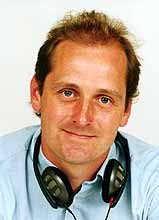 | | | | "Home Planet is the environmental programme for which you set the agenda. We tackle your questions and concerns and try and make some sense out of the conflicting opinions which make up the environmental debate."
Richard Daniel | | | | |
| | | | | | PROGRAMME DETAILS | | | |
|  | |
Panel
Dr Madeline Havard
Chief Executive, Wildlife Trust of South and West Wales
Dr Roger Key
Invertebrate Biologist, English Nature
Professor Philip Stott
Bio-geographer, University of London
TOPICS
Ticks and Lyme Disease
Net Doctor
Microscopy UK
Do fizzy drinks add to the C02 in the atmosphere?
Philip Stott's on-air experiment, a simple way to work out how much carbon dioxide there is in a fizzy drink:
Take a fizzy drink bottle, ensuring that the drink has been settled for some time, and weigh the bottle on your most sensitive kitchen scales. Weigh an empty bottle of the same kind so that you can work out the weight of the liquid alone. Shake the full bottle thoroughly and let the froth subside completely (this is most important). Then, carefully open the cap a fraction so that the gas alone can escape safely from the bottle. When all the gas has escaped, close the cap firmly and reweigh the bottle. You can now calculate the weight of the carbon dioxide released from the bottle, as well as the grams of carbon dioxide per litre of liquid.
This little experiment can be refined in two neat ways.
(a) First, you can draw a graph showing the amount of carbon dioxide released for one shake, two shakes, and so on, until around 15 shakes, when, in most cases, all the gas under pressure will have been released from the bottle (a tiny amount will remain dissolved at atmospheric pressure). For a 450 ml bottle, you will probably get between 2.2g to 2.4g of carbon dioxide after 15 shakes.
(b) Secondly, you can calculate the differing amounts of carbon dioxide released from the bottle at different temperatures; the colder the bottle, the less carbon dioxide will be released per shake.
Are there scorpions in the UK?
University of Sussex: scorpions on Sheerness
University of Exeter: bug club
Have our National Parks helped nature conservation?
Association of National Park Authorities
Council for National Parks
Scottish Executive Consultation Paper
National Parks Scotland Act
Ladybird spiders
BBC Nature
UK Biodiversity Action Plan
English Nature
Contact Home Planet
Send your comments and questions for future programmes to:
Home Planet
BBC Radio 4
PO Box 3096
Brighton BN1 1PL
Or email the programme: home.planet@bbc.co.uk
Or telephone the Audience Line 03700 100 400
Home Planet is a Pier Production for BBC Radio 4 and is produced by Nick Patrick.
The personal information you provide will be held by the BBC and by Pier Productions Ltd, the independent production company which makes Home Planet. Your information will be used for the purpose of creating the Home Planet programme, and will be processed in accordance with the Data Protection Act 1998. For more details on how the BBC deals with your information, please see the BBC’s Privacy and Cookies Policy at http://www.bbc.co.uk/privacy
| | |
OTHER RELATED LINKS
Environment Agency
English Nature
The BBC is not responsible for the content of external websites
| |
| | |