| | | | | | | | | |

| | | FRONTIERS
|  | |  | MISSED A PROGRAMME?
Go to the Listen Again page | | | | | | | PROGRAMME INFO | | | |
| | | Frontiers explores new ideas in science, meeting the researchers who see the world through fresh eyes and challenge existing theories - as well as hearing from their critics. Many such developments create new ethical and moral questions and Frontiers is not afraid to consider these.
| | | | | | Contact Frontiers | | | | | LISTEN AGAIN 30 min 30 min | | | |
|
|
|  | | | | |
| | |
| | | | | | PROGRAMME DETAILS | | | |
| 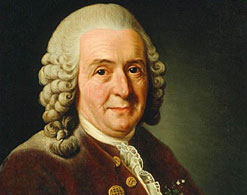 | | Carl Linnaeus,
painted by Alexander Roslin (1775) |
Linnaeus
Peter Evans celebrates the 300th anniversary of Carl Linnaeus, the Swedish Natural Historian, who gave us many of the names of plants and animals we still use today.
300 years on, Frontiers examines how this great and complicated man has influenced modern day biologists.
Today’s taxonomists are now more familiar with a bewildering array of high tech microscopes and gene sequencing instruments, rather than the traditional collecting jar and butterfly net.
Linnaeus, of course, knew nothing of genes, but what would he have made of these new methods of identifying creatures, looking not just at their physical appearance and behaviour, but also at their DNA to unravel clues about our evolutionary tree.
With this new-found knowledge, does Linneaus’ naming system, so beloved by botanists and biologists the world over, still hold true today? | | |
RELATED LINKS
The Linnean Society: Carl Linnaeus
The Linnaeus Celebration
Natural History Museum: Linnaeus Link
J. Craig Venter Institute
UCL: Prof. Steve Jones
BBC Radio 4: Material World - Carl Linnaeus
BBCi Science
The BBC is not responsible for the content of external websites
| |
| | |
|