| | | | | | | | | |

| | | FRONTIERS
|  | |  | MISSED A PROGRAMME?
Go to the Listen Again page | | | | | | | PROGRAMME INFO | | | |
| | | Frontiers explores new ideas in science, meeting the researchers who see the world through fresh eyes and challenge existing theories - as well as hearing from their critics. Many such developments create new ethical and moral questions and Frontiers is not afraid to consider these.
radioscience@bbc.co.uk | | | | | LISTEN AGAIN 30 min 30 min | | | |
|
|
| | | | | |
| | |
| | | | | | PROGRAMME DETAILS | | | |
| 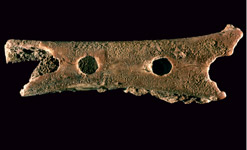 | | © Marko Zaplatil
Institute of Archaeology ZRC SAZU
Ljubljana, Slovenia |
Recent discoveries of bone flutes suggest that man was making music forty thousand years ago.
Cavemen
Peter Evans visits a Palaeolithic cave to see evidence of our ancestors' musicality. Even playing stalactites came into their repertoire!
But could man's musical abilities have developed much earlier than this - more than two hundred thousand years ago?
Standing on two feet
'Yes' argues archaeologist Iain Morley. His research suggests our musical voice developed as we started walking on two legs. And this happened about 1.75 million years ago.
Musical intuition
Music therapist Nigel Osborne and psychologist Colwyn Trevarthen push our innate musicality even further back. They believe our reaction to music is based on an intuitive mechanism evolved over billions of years.
Could this intuitive response explain why babies react to music so positively?
Peter Evans explores the evolutionary function of music in the first of a new series of Frontiers.
Next week: Optical Tweezers - how light can manipulate atoms and molecules. | | |
RELATED LINKS
Science & Music at Cambridge University
Ian Cross
Steven Mithen
Colwyn Trevarthen
Nigel Osborne
Cresswell Caves
BBCi Science - Human Evolution
The BBC is not responsible for the content of external websites
| |
| | |
|