| | | | | | | | | |

| | | THE COSMIC HUNTERS
|  | |  | MISSED A PROGRAMME?
Go to the Listen Again page | | | | | The astronomers who are searching beyond the stars. | | | |
| |
Earth-like planets around distant stars… the first stars and galaxies in the Universe… and the repulsive stuff that makes up three quarters of the Cosmos but about which scientists embarrassingly know next to nothing. These are the three most exciting and important quests for astronomers in our times. In this three-part series, Chris Riley visits the key players at their telescopes and labs to find out about their ingenuous celestial hunting methods and what drives them in their quests.
Read presenter Chris Riley's article about the series on BBC News.
| | | 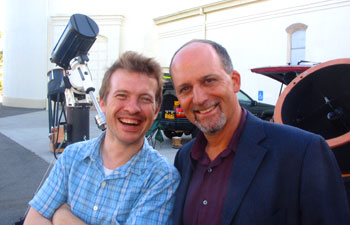 | | Presenter Chris Riley (l) and astronomer Geoff Marcy (r) at the
Lick Observatory in California (credit: Andrew Luck-Baker) |
Programme 1
Are there habitable planets like the Earth throughout the galaxy?
Nobody knows at the moment, but Chris Riley meets some of the astronomers leading the search to answer this question.
Earth-like planets in orbit around distant stars are impossible to see directly because they're so small and dim, but within a few years clever tricks of astronomical detective work should reveal them - if they're there.
In the first programme in the series, Chris talks to two of the world's foremost planet hunters at their observatories.
First he meets Didier Queloz of the University of Geneva who detected the first known extra-solar planet in 1995 from an observatory in southern France.
Chris also tours the planet searching facilities of the Lick Observatory in the company of Geoff Marcy of the University of California, Berkeley.
Marcy's team holds the record for the smallest extra-solar planet found to date.
Both astronomers discuss the techniques they are using to find Earth-like planets and the motivations which drive them in their quest.
Related Links for Programme 1:
California and Carnegie Planet Search
The Geneva Extrasolar Planet Search
Carnegie Institution: Alan Boss
Carnegie Institution: Sarah Seager
 Listen again to programme 1 Listen again to programme 1 | | 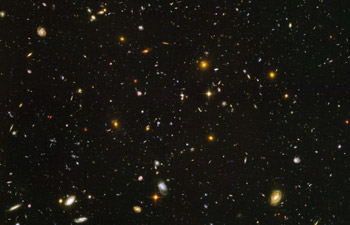 | | The Hubble Ultra Deep Field
(credit: NASA, ESA, S. Beckwith (STScI) and the HUDF Team) |
Programme 2
The further across the cosmos astronomers see with their telescopes, the further back in its history they're looking. Already they can see back more than thirteen billion years - picking up objects billions of times fainter than stars we can see with the naked eye.
In the second programme in the series, Chris joins astronomers who are using their telescopes to search for the Cosmic Dawn - the time in the Universe's childhood when its first stars burst into life and its billions of galaxies came into being.
Related Links for Programme 2:
The First Galaxies
Searching for First Light
The Hubble Ultra Deep Field
The First Stars in the Universe
NASA: The James Webb Space Telescope
Listen again to programme 2 | | 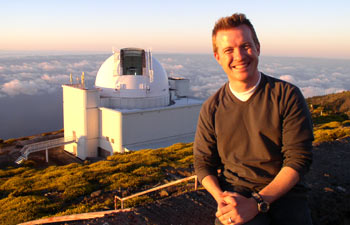 | | | Chris Riley, presenter |
Programme 3
In the last few years, astronomers have come to realise that the Universe is largely made of mysterious stuff which they've named Dark Energy.
This dominant constituent part of the cosmos is causing the Universe to expand at ever faster speeds and physicists are at a loss to explain what it is.
It's up to the astronomers with their telescopes to come up with more detailed evidence to pin down the nature of Dark Energy.
Chris Riley talks to some of the scientists at the forefront of the quest - a cosmic hunt which could revolutionise our understanding of the fundamental laws of the nature.
Related Links for Programme 3:
The Space Telescope Science Institute: Adam Riess
Supernova Cosmology Project
University of Oxford: Isobel Hook
Johns Hopkins University: Charles Bennett
SNAP (Supernova/Acceleration Probe)
Listen again to programme 3 | | |
RELATED LINKS | | | BBC Science & Nature
The BBC is not responsible for the content of external websites
| | |
| | |
|