| | | | | | | | | |

| | | ARTHUR C. CLARKE: THE SCIENCE AND THE FICTION
|  | |  | MISSED A PROGRAMME?
Go to the Listen Again page | | | | | Heather Couper meets the man behind the ideas | | | |
| |
Sixty years ago this month, in October 1945, the magazine Wireless World published an article by a relatively unknown writer and rocket enthusiast. Its title was: "Extra-Terrestrial Relays: Can Rocket Stations Give World Wide Radio Coverage?" Today, the author's name is known throughout the world. He is the science fiction writer Arthur C Clarke, and his prediction of satellite communications has come true in ways even he never imagined. To mark the anniversary, Heather Couper travels to Sir Arthur's home in Sri Lanka to hear his own story.
| | | 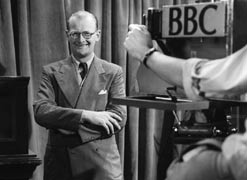 | | | Arthur C Clarke speaks to the BBC in 1953 |
Today it is sometimes still referred to as the Clarke Orbit. It's that orbit in space, 36,000 km above the equator, where a satellite takes exactly 24 hours to orbit the Earth. So the satellite orbits at the same rate as the planet itself spins, seeming to hover over the same place on the equator.
Thus it makes possible radio communications with fixed receivers on the ground such as the satellite TV dishes springing up on millions of homes. Yet Clarke made his prediction before TV became widespread, before the invention of the transistor and long before the first space rocket.
Clarke, then in his twenties and still without a science degree, spent the second World War working on the use of radar. He'd become an early member of the British Interplanetary Society, a group of enthusiasts who had realised the potential of space flight long before rockets first left the atmosphere.
"Somewhere in me is a curiosity sensor. I want to know what's over the next hill. You know, people can live longer without food than without information. Without information, you'd go crazy", he says.
In 1945 Clarke envisaged his radio relay rockets being built from the technology of the day - vacuum tubes or 'valves'. They are big, power-hungry and unreliable. So Clarke imagined his satellites as vast orbiting space stations, manned by teams of engineers performing maintenance and regularly supplied by rocket flights from Earth. The miniaturisation that became possible with the transistor, he says, took him by surprise.
| | 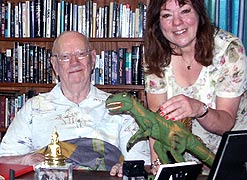 | | | Sir Arthur in his library, with Heather Couper and friend. |
By the 1950s, Clarke's curiosity had driven him beyond science fact and into fiction; the genre that brought him fame with books and films such as 2001, A Space Odyssey. But he has always been careful to keep the science in his fiction as an accurate if imaginative extension of the science we already know.
It was also in the 1950s that he discovered the pleasures of scuba diving. Realising that he might not get to fly in space himself, he found diving to be the next best thing - a chance to explore a new and wonderful world in an approximation to weightlessness. So it was for the coral reefs and diving that he moved to Sri Lanka where he still lives, though contracting polio in 1962 has limited his diving.
It is in Sri Lanka that he set another of his novels, The Fountains of Paradise, based around the construction of a space elevator as a means for reaching his 'Clarke Orbit' without rockets. When he wrote it, he says, it seemed fantasy, but soon afterwards, the discovery of the form of carbon known as buckminsterfullerene made possible, at least in theory, the super-strong materials needed.
In this programme, Heather Couper hears Sir Arthur's own story and meets with family, fans and fiction writers he has influenced. His younger brother Fred remembers their childhood on a Somerset farm: Arthur was building telescopes and launching home-made rockets. Did the other children join in their brother's activities? "No!", recalls Fred with a shudder. "We kept away from the dangerous blighter".
 Listen again to the programme Listen again to the programme | | |
RELATED LINKS | | | BBC Science & Nature
The BBC is not responsible for the content of external websites
| | |
| | |
|