| | | PROGRAMME INFO | | | |
| |
 Between the ages of 11 and 16, most young people are expected to sit in classrooms and be taught 'academic' subjects. This may suit many - maybe the majority - but for a very sizeable minority, it doesn't. Between the ages of 11 and 16, most young people are expected to sit in classrooms and be taught 'academic' subjects. This may suit many - maybe the majority - but for a very sizeable minority, it doesn't.
| | | 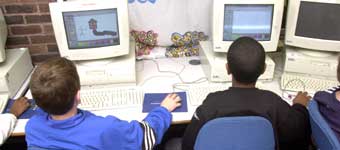 Should children be prepared for the world of work?Lines open at 1.30pm, and the number to call is 0870 010 0444 Should children be prepared for the world of work?Lines open at 1.30pm, and the number to call is 0870 010 0444 | |
They think it's irrelevant, childish and 'uncool'. The result is breakdown…and we've seen too many devastating events in recent times - from the events on the North Peckham Estate in London to the jailing this week of a mother for her children's truancy.
Many young people have talents…and we're failing them if we don't help them to develop them. We have to be more imaginative and set these people "free" from the current straitjacket…and that means we have to develop other ways of educating them.
How?
I think that at the age of 14, many such youngsters should be steered in the direction of properly-structured vocational education (which generally prepares people for the world of work)…and training (which prepares people for particular jobs).
Such education and training would partly be in the workplace (with pay) and partly in the classroom - not least of all to ensure that literacy and numeracy skills are brought up to standard. Their wider education would most certainly not stop at 14 - far from it.
Surely this would be seen as much more relevant, and help to engage them?
And, yes, it would vastly help their job prospects - their 'employability'.
And it would help them to share in the good things of life - rather than feeling that they were being excluded from them. The school leaving age until 1947 was 14 - and had been for nearly 30 years.
At 14, many non-academic young people moved straight into the grown-up world of work. Many became apprentices, learned a "trade" and became superb craftsmen. They were growing up, starting to earn and planning for a future knowing they were 'employable'. They saw 'point' to it all and knew they would have a place in society.
How different from the experiences of many of today's 14-to-16 year olds who sit in hated and despised classrooms, seeing no 'point' to it at all.
It's not just a waste of their time. It's worse.
They become disruptive…they become alienated…they truant - note the strange case of the recently jailed mother because two of her daughters habitually truanted - and they turn to crime.
These young people become, all too often, quite 'unemployable'.
And what makes it worse is that as many as 1 in 10 young people leave school, after 11 years of compulsory schooling, without adequate literacy and numeracy skills.
1 in 10: this is one of the worst records in the developed world and can only contribute to the social problems of areas such as the Peckham estate where Damilola Taylor so tragically died.
By Ruth Lea, Director of Policy, The Institute of Directors
Lines open at 1.30pm, and the number to call is 0870 010 0444
| | |
RELATED LINKS | | | - Institute of Directors
| | |
| | |