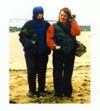
Rebecca Harris is twenty-three and has just graduated from the University of Hertfordshire with a first-class degree in Fine Art. Rebecca is blind, and for the last two years has worked with the help of a sighted assitant, Anne Noble-Partridge. The course is over now, and both women going their separate ways. Judi Herman talked to them about the ups and downs of their relationship. Neither Rebecca nor Anne knew each other before they began working together. A couple of phone conversations, and that was it, they met up, and from that moment, the relationship had to work.
"You have to be professional regardless of how you feel about each other," says Rebecca. Anne found the first day nerve-wracking, "I'd never met anyone with a visual impairment or disability at all. But within days they were off at their first art exhibition together at the National Gallery in London. It told Anne a lot about how Rebecca worked, "In one exhibition, which had a spotlit Jesus figure, everyone watched Rebecca. It's fascinating to watch her feel and touch the sculptures. This man was naked, and she got down to hip level and everything went very quiet. Then the curator said, "You might get a surprise in a minute!"
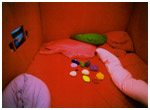
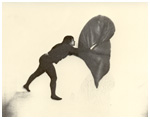
Rebecca works a great deal with the idea of boundaries and moving around in spaces. One of her installations is almost like a soft red room, full of differently shaped and textured cushions. A video of Rebecca in a field with the wind catching at a floating piece of material plays in the background.
"I've got labels on the walls which say things like, 'Touch Me' and 'Stroke Me'," says Rebecca. Sound is important too. Judi picks up a pink cushion shaped like a boxing glove, labelled with the command 'Hit Me'. She does and it responds with a manic laugh from within, surprising Judi into laughter too. Anne and Rebecca have had to find their way of working together. Anne sets up the equipment and takes the photograph for Rebecca, and cuts out the fabric for her installations. Rebecca says, "There's a constant discussion about ideas and how we're going to do things." They have moments when the intense nature of their relationship gets on their nerves. "It's frustrating for Rebecca if I can't do something and she wants me to do it," says Anne. "We couldn't get angry with each other, because the trust we had would go. We never really argued."
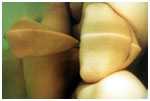
Photography is important to Rebecca. She has developed a distinctive style of black and white photographs which are raised off the paper, "You put the heat-sensitive paper in the machine which raises the black surfaces on it, which become positive. The white space round it is negative - they're tactile photographs."
Anne is also an artist, a fact which made it important for the two women to address the rather complicated issue of their individual approaches from the start. Rebecca hesitates as she considers whether her work has Anne 'in it', "Um - I'm not sure I'd take it that far. I do the performance, and Anne set up the camera. But Anne's going to influence me just by saying what's going on round me."
Their working relationship is over now, "It was quite a relief," admits Anne, "The whole thing had got so intense." Rebecca feels the same, but found the sudden halt to their closeness a little weird. They still see each other, but on a different basis, "It's a lot easier, and we're friends..." says Anne.