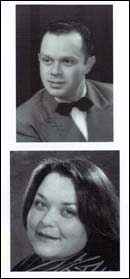
Jenny Adams-Barbero is a professional singer, but it wasn't until she was thirteen that she discovered that her father was a musician and someone she'd seen many times before on television... Every Saturday evening, Jenny watched the Billy Cotton Band show in the home of her foster parents. She loved the show. Her foster parents even bought her a toy trumpet which, mysteriously, used to get hidden away whenever Jenny's mum came to visit, "for fear of causing offence".
Jenny had never known her father, who had left her mother when she became pregnant, telling her only then that he was already married. At thirteen, Jenny decided - on the way to the bus stop - to ask her mother who her father was, "I said was it someone in Billy Cotton's Band, and she said 'Yes'! I asked which one, and she told me it was the one who comes out to play solo trumpet each week - Grisha Farfel."
During her school years Jenny wrote letters to her father, but always tore them up. Later she tried the Salvation Army who were unable to help her on the grounds that it might disrupt Grisha's marriage, "I decided I would honour that, and keep quiet," says Jenny, "I regret the decision now terribly."
Eventually, Jenny a singer with the BBC Singers, asked a fellow musician, trumpeter Michael Laird of the BBC Symphony Orchestra for help. She'd heard that her father had emigrated to Los Angeles. On Jenny's behalf, Michael contacted the Musicians' Union in America. Grisha, it turned out, was a childhood hero of his. The address languished in Jenny's address book for years without her making contact, "I held back. I needed a thrid party," she explains, "I found it when Luisa, now fourteen, was born. Nothing else mattered - I wanted to my father to know he had a daughter who is a professional singer, and now a grandchild."
Jenny's sister-in-law in Conneticut made the phone call for her, explaining to the woman who answered that an old colleague wanted to get in touch with Grisha. The woman was Grisha's wife, and Grisha had died six months before the call. "I never did meet him," says Jenny, "I was absolutely devastated."
Some weeks later, Jenny felt ready to talk to her own mother about it. During the phone call, Jenny, who'd been determined not to breakdown, did so. "My mother said, 'Why are you crying?' I said, 'He was my father. Whatever went on between you and him, he was my father.'"
Ten years later, Jenny typed her father's name into the internet. One of the two results was a Jewish Genealogical website, which astonished Jenny who had no idea her father might be Jewish. She filled in her father's details, and six weeks letter received a reply from someone in South Africa who put her in touch with a woman in America who recalled that someone else had been searching for a Grisha Farfel.
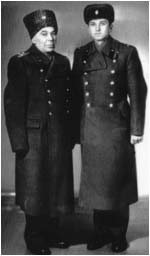
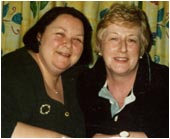
It was Aleksey, Grisha's brother. The two had been parted over sixty years ago in Russia, when their parents were killed. Aleksey had recently left Russia, where he and his son Misha were in the Red Army, to live in Orlando, Florida. Jenny got in touch with Aleksey, and ten days later, she flew out to meet Uncle Aleksey and his family, especially her cousins, Misha and Natasha. Returning to London, Jenny carried on the detective work of piecing together her fragmented family connections. Her advert in The Jewish Chronicle, prompted Jack Rothstein, a classical violinist to get in touch with her. He told her the name of her sister, Laura, and gave her an address. It turned out to be the wrong one, but led eventually to Laura.
Jenny's persistance in finding out about her father did affect her relationship with her mother, who couldn't understand why her daughter wanted to find him, "I'm curious," Jenny told her, "and it's my right to know. Eventually my mother wrote me a little note saying she thought I'd been very brave and courageous, and it was indeed my right to know."