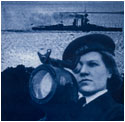
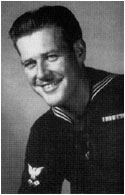
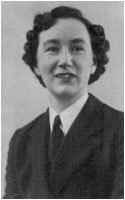
In 1944, Jack Cambell and Stephanie Batstone struck up a relationship using an unusual method of communication. They never met. Then Jack vanished. Fifty seven years later at the Imperial War Museum, with reporter Sara Parker, they met face to face for the first time. During Word War II, Jack Campbell was a signalman in the US Navy. For thirty days his ship was anchored off the Scottish coast in the Firth of Lorne near Oban. Life got a bit lonely on board, so Jack started up a conversation with the shore station - by Aldis lamp. An Aldis lamp was also known as a 'blinker' and was used to flash messages from ship to shore.
Stephanie Batstone, a trainee Wren, got 'talking' to Jack by Aldis lamp after he'd helped her out by passing messages onto another ship. Whilst Jack and Stephanie never saw each other, they struck up a relationship across the night waters. "You could say anything to a man on a ship, several miles off! You knew you'd probably never meet them!" remembers Stephanie, ""We were like two people on separate desert islands."
Both Jack and Stephanie were highly proficient signallers. "It was a secret language," says Stephanie, "Another signalman could read what you were saying, but nobody else could."
One evening, their 'chat' became more personal, "I came on duty one evening," says Stephanie, "and called Jack up because I knew him a bit by then and signalled, 'What have you been doing all day?' and he signalled back, 'Waiting for you to call me back.'" Neither Stephanie nor Jack reveals what was said by blinker, but Stephanie recalls, "If you kept the light on for a little bit longer, it was a kiss I suppose."
Then one morning, invasion in the air, Stephanie looked out across the sea, "The anchorage was completely empty. There were no ships at all. We asked around to find out where they'd gone." It was D-Day, and Allied naval forces were landing on the Northern Coast of France. "I felt he hadn't survived. We heard later that the ships were sunk. The invasion had started from Oban - and that's the big romance of it all."
Jack had written to Stephanie, and she had tried to contact him, but wartime has little respect for relationships or the postal service. Fifty years on Jack describes their exchanges as, "just a flirtation."
Fifty seven years later, Jack and Stephanie met for the first time. Stephanie had never married. Jack had, and it was his daughter Nicky, at Jack's request, who made contact with Stephanie on a visit to Britain.
"I told this story many times," says Jack, "imagine sitting five miles from somebody and carry on a conversation by light and never meeting them. It's thrilling after fifty-seven years to meet somebody I've never talked to."
(Wren's Eye View - Adventures of a Visual Signaller by Stephanie Batstone, is published by Parapress Ltd, Tunbridge Wells)