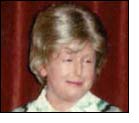
Sheila Dray has a rare congenital skin disease called Netherton Syndrome. The symptoms are a little like those of alopecia and Sheila has worn wigs from the age of 5. She explains how the illness has affected her life...
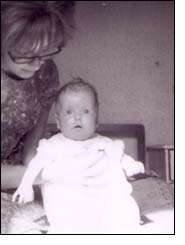 Sheila at a few months old |
Until the 1960s many babies born with Netherton Syndrome didn’t survive. But as far as she knows, Sheila Dray is the oldest survivor - a fact that she finds a bit frightening.
Sheila wasn’t diagnosed immediately. In fact, it foxed doctors for quite a while. Eventually, they concluded it was eczema. It wasn’t until five years ago, when she became very ill, that she received an accurate diagnosis.
The external signs of Netherton Syndrome are very little hair everywhere, red and scaly skin which is hot to the touch, a great thirst and a tendency to pick up infections very easily. This is a very rare illness and Sheila has only ever come across four other sufferers.
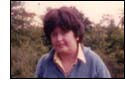 bubbly brunette |
From the age of four Sheila wore a wig. She says, "everybody panicked when it was school time and thought she ought to look as normal as possible". She was given an adult’s NHS nylon wig which looked a bit strange on a child. The wigs themselves were of varying quality. NHS wigs were always nylon because that was cheaper and they were easier to care for. They did, however, have their drawbacks, "if you got too near the iron with them, they’d fry".
She enjoyed being a teenager, but says that because of her illness, boyfriends weren’t on the agenda. "When there are all these gorgeous looking 15 year olds out there with their own hair, you don’t get a look-in". But she says she had good fun passing messages from her friends to their boyfriends and thinks she might have learned from their mistakes with her own relationships later on.
In the past she’s got quite adventurous with wigs. Once Sheila left school she started with blond and discovered that blondes do in fact have more fun. Then went red headed which she describes as gorgeous.
Relationships in her teens and 20s were a bit of a problem. When you have been teased, she says, you tend to build up a little bit of a brick wall. Then she met someone who had a false leg. "We made a great couple - his false leg, my false hair - we got on famously". He taught her to laugh at herself. But they went their separate ways eventually.
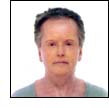 Sheila now |
She decided fairly early on that she would never have any children. There is a faint chance that if her partner had the similar faulty gene that causes Netherton, the Syndrome would be passed on to their children. She says this wasn’t a difficult decision as she isn’t very motherly.
Sheila no longer wears wigs and describes herself as looking like a hedgehog. Her hair never grows much beyond her ears and is very brittle. It was her current partner who got her out of that. When she first went out in public without her wig, it felt very cold. She says, "It felt wonderful".
More Information
Ichthyosis Support Group
Pamelia Catlyn-Ranger
National Contact
16 Cambridge Court
Cambridge Avenue
Kilburn
London NW6 5AB
Tel: 020 7461 9034
Hairline International
Lyons Court
1668 High Street
Knowle
West Midlands
B93 0LY