Radio 4
Home Truths
Listen Again
About John Peel
| | |
FROM YOU - Glis glis
C Highmore writes:
'When my wife and I moved to leafy Buckinghamshire, we purchased a small bungalow in need of repair and employed Steve, a local builder, to do the work.
All went well, until one particular night halfway though the building work. My wife and I were sleeping on mattresses on the floor in one of the rebuilt rooms with our heads against the wall adjoining the room that was being converted into a bathroom. The floor was 'up', so that Steve could create the necessary 'nest' of pipe work.
We woke in the early hours to the sound of pattering feet, and frantic crashes and bangs coming from under our floor and from the next room. I sent my wife to investigate whilst I stood guard over the mattresses. She reported zero sightings so returned to her mattress. No sooner had we started to drift off into an uneasy sleep, than the noises began again.
Steve and the 'lads' found us next morning with red-rimmed eyes and trembling gently from lack of sleep mingled generously with fear. The team gathered over their early morning coffee and debated the situation. The work had to go on but what could we do about the unnamed beast under the floor? We were stuck unless we knew what we were up against. Then 'Greg' the plasterer arrived and he knew what it was.
'What you 'ave 'ere is a Glisglis!' he pronounced with total confidence. 'You can't kill 'em cos they're a protected species,' he added.
I sought local advice in the local pub. Not much success there but the beer helped me relax and then I struck lucky! I discovered that my friend and neighbour, one John Holman of Home Truths fame, knew how to deal with Glisglis.
Listeners to last week's programme may recall John's ingenious method of smoking out the animal with burning toast, trapping it with a saucepan lid and a kitchen sieve and then disposing of it some distance away. John offered me his humane Glisglis trap and said I should use apple to entice the little blighter. I hardly heard his offer as my mind raced on and I began to put two and two together. I knew now where my Glisglis had come from! Thanks John!
As I had no intention of seeking isolated farms in Buckinghamshire where I could deposit our visitor, I used another method. Sorry, John, you didn't see me creeping through your back fence one dark night clutching a saucepan lid and kitchen sieve tightly held around a frantic furry little animal... All yours mate! Just don't try bringing it back this way.'
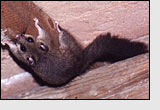
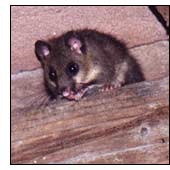
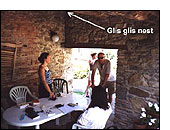
Darren Tansley emailed us with these photos from a recent trip to Italy.
'We were staying in an old water mill above a river gorge and the lean-to area that we had our meals in had large beams jutting out of the roof space. On the first night my partner Sue came in to say she could see a squirrel up in the rafters. When I went out I realised it was an Edible Dormouse (Glis glis). Over the next week we saw the dormouse most evenings just after dusk. It would dash out clinging to the underside of the rafters then disappear down a vertical wall and off into the woods.On the fifth night we saw two adults and a baby or possibly two peering out from the rafters. Sue took these pictures of the first one (with the notched ear) on the third night. Contrary to what they look like in the flash, it was pitch dark by the time they emerged. I think she did pretty well.
The final day we returned home to find four babies had tumbled out of the rafters. Two were dead on the floor, one was clinging to a chair and another was attempting to climb back up the wall. I placed the two survivors in a cardboard box with oak leaves for bedding and bramble fruits as a temporary measure. I was worried that the young, still not old enough or strong enough to fend for themselves, had tumbled out looking while for the parents. If this was true, then placing them back in the rafters would have been pointless.
That evening (our last) we had almost given up watching for the parent when at about 10pm the female returned, much to everyone's delight. I carefully placed the two juveniles back into the roofspace and then we all left the area alone.
The following morning there were no signs of the young falling out so we hope that they have survived. Glis glis only have one litter per year, usually 4-5 and I expect mortality rates are high as with any small mammal, but although it was sad to see two young perish, it was also a fascinating interlude to the holiday and I guess I am one of the few ecologists in Essex to get some handling experience of Glis glis in the wild!
MORE INFORMATION:
Information on the Glis glis
More photos of Glis Glis
The BBC is not responsible for the content of external websites. | |
| |
| |