Radio 4
Home Truths
Listen Again
About John Peel
| | |
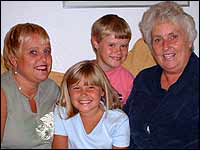
Adoptive Daughters Diane Wakefield and Dot Ellis are cousins who share a house. Dot's mum also lived with them when Di decided that she wanted to adopt... Di was a single, forty year old career woman managing a new drugs service in Liverpool when she decided to adopt. In the past a single person wouldn't have been able to adopt, but times have changed.
She had a looked after a couple of boys for five weeks when they'd come to Britain from Chernobyl to receive medial treatment, and a friend working in an adoption agency asked whether she'd ever considered adoption.
Di was immediately taken with the idea, but she shared a house with Dot and her mother. Dot's own daughter had died of cystic fibrosis aged 14 so the decision was emotionally fraught for her. But she wanted children back in the house. It was a time when her friends were becoming grandmothers. Her own mum was very encouraging. She was an active 86 year old and thought it was an excellent idea.
Paige was 4 and April was 6 when they were adopted. They were pale, withdrawn and unhealthy children. They hadn't been to school or playgroup, had no social skills, and no idea of even how to use a knife and fork.
Paige was a very angry little girl when she came to live with Di and Dot. Withdrawn and unsmiling, she was angry about what had happened to her. April was like the 'Tasmanian devil'. She was very aggressive, and she obviously missed her old life. All that could be done was to hold her in a blanket until she calmed down. She had been Paige's mother for so long that she had to learn how to be a little girl again. It took some time for the girls to settle, and every day is still different.
Diane took two years off work. She is a nurse, so she worked over night shifts a couple of nights a week to keep her skills up, but was always there during the day for the girls. Both doing splendidly now.
Di and Dot don't regret adopting the girls for a second. Dot feels the girls have given her a purpose, a quality of life she hadn't ever expected to find.
Di chose to adopt children rather than babies, and she didn't go through the emotional hurdles of IVF. She thinks that this makes her hopes and expectations for her girls and for her relationship with them more straight forward than might otherwise be the case. She wants to give them the opportunity to make choices in their lives. If Paige and April decide to investigate their past when they're older, Di will encourage it, and hopes they'll have the security and maturity to be able to deal with what they find.
As for the girls, they are quite at ease about their aadoption. When they fist came to live with Dot and di they thought everyone was adopted. "Where did you get him from?" they asked Di's friend, looking at her son. More information on Adoption in the UK:
British Adoption And Fostering Association
Adoption
Department of Health Information site
TalkAdoption
A free phone line for young people to talk about adoption
If adoption has transformed your life
Tell us about it on the message board
The BBC is not responsible for the content of external websites. | |
| |
| |