Clare Jenkins visits Captain Roy Abbott in India, and his cousin Meredyth in Rotherham, to find out about his 'eccentric' colonial lifestyle...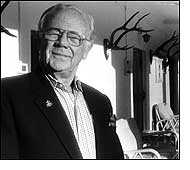
Captain Abbott on his verandah (photo reproduced with the kind permission of Stephen McClarence, Sheffield).
|
Captain Roy "Bud" Abbott is the last British farmer in India and responsible for the livelihoods of 3000 villagers in Madhya Pradesh. He spends long periods in India during the harvest, when he can go for days and days without speaking any English at all. He is an ex-army officer, and feels that farming is "probably the best thing an army officer can do - it's an open air life, you're not sitting behind an office table all day long". He is now the last member of the Abbott family. Captain Abbott's second cousin Meredyth Harris, points out that he has done a great deal for the villagers who work on his farm. "He's dug wells for the villagers, he's built temples, if someone's having a wedding and they can't quite make the bill he'll lend them the money, he's quite often a taxi service for the staff if he feels it's warranted". They do have to put in a chit for such things, and justify their requests, and it all has to be in writing and every bit of paper is kept.
Captain Abbott gets up at six o'clock, checks that the staff have been allotted tasks and if everything's fine he has a wash and some breakfast, and then gets down to his accounts. He has a housekeeper Lilla who is in charge of the household, and approximately a hundred other staff. Meredyth describes his life as "eccentric", and it is certainly very regimented. "He tries to run his life like the Army. That doesn't always work and that frustrates him. He's very much a perfectionist". Lilla confirms that staff are 'fined' if items are misplaced, for example.
Captain Abbott has a great deal of rules in the house, and standards which he expects to be upheld. He must have his tea stewed for a certain length of time, and served with hot milk, and he has a small whisky followed by a hot bath every evening. Whilst in the bath (water at the correct temperature) he listens to the World Service. Sometimes people will come to see him about their problems, and talk to him through the bathroom window (he tells people they can come and see him at anytime) and then he has his three course meal (with the same pudding - creme caramel with poached fruit - every day) around 10.30pm.
The Captain likes to change for dinner, even if he's dining alone. "I think it's just force of habit. I did it when my wife was alive....I'm just keeping up standards". He likes to have the cutlery and everything else on the table in the right place, and the servants must wear their uniforms and gloves. Lilla recalls that his parents were exactly the same. The Captain readily admits : "I'm a traditionalist and an incurable romantic. I love all the old things, I hate change because I think that way of life was a lot better than it is today. It's much too casual for me".
The Captain enjoys his regular visits back home to England, and likes the 'efficiency' and orderliness of things like the traffic and queues in the post office and the bank. Things in India, by comparison, are terribly disorganised. What he doesn't like about Britain is the weather, of course, and things like the graffiti. Meredyth doesn't feel he could ever live in Britain again, partly because of his lifestyle and also because he genuinely loves India so much. He was born, brought up, educated and married there, and all his family are in the local cemetary. "I think I'm more Indian now than British, having lived here all my life and possibly for the remainder of my days. My living habits are not Indian, but I do consider myself to be more Indian than British".