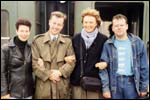
For Krystyna Markiovitz the past 12 months have not been so much the beginning of a new life, but the fulfilment of a long-held wish Krystyna lost her mother earlier this year, and only then did she feel she could take the trip she'd long been planning - to retrace her mother's wartime footsteps from Polish Belarus to a labour camp in Ulskoye in Northern Russia. Last summer Krystyna made an audio diary of this trip. Her mother, along with other members of her family, was taken from a part of Poland, now in Belarus, up to Arkhangelsk to a Soviet labour camp. The adults in the family died in this camp only a few months later in 1940 - only Krystyna's mother and her uncle - then aged 4 and 10, survived. When the Soviet Union joined the Allies, the children escaped from the camp. They set off to walk the hundred kilometres and more back to Archangel where they planned to join the Allied forces. The children weren't allowed to join up, being told that they were too young, too sick and too thin. The pair then turned around and walked south, all the way to Persia where the Shah was offering refugees safe haven. They made it to Persia, ended up in a British refugee camp in Palestine, and from there came to Britain. Krystyna's mother married here and raised a family, and her brother emigrated to Australia where he still lives. An epic family story.
Krystyna's mother never shook off a life-long fear of all things Russian, and got upset at the idea of her daughter retracing her steps, but for Krystyna it was one of the stories she grew up with, and so following her mother's death last spring she set out to complete stage one of what will be a two year trip. Her audio diary provides a snapshot of her journey, and features the friends she made as much as the journey itself.
In mid-August, after three days and nights on a train, heading ever further north, she arrived in Arkhangelsk and there she met two Russians, Ruslan and Ludmilla, two young university researchers who decided to devote their holiday to helping a complete stranger. They became Krystyna's firm friends and helped enormously with her quest. They began by seeking her family in the State Archives, and were lucky enough to find records of them. Locating the camp was not so straightforward. They knew that her mother and uncle had arrived in the camp in 1940, but it was abandoned long ago, and doesn't exist on contemporary maps. Falling back on her Uncle's memory of his journey, Krystyna recalled the camp had been in the region of a village called Arlitse, an eight-hour boat trip away up the river Dvina. Krystyna, with Ruslan and Ludmilla determined to keep her company, set off for Arlitse to see if they could find anyone who remembered the camp.
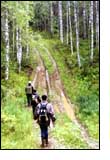 |
She encountered more helpful Russians in this village, one of whom guided her through the forest to where the camp had been. Only two buildings remain, both of which had probably been used to house families. Krystyna sits in one of the buildings. "I suppose at last it's really hit home to me. Yes I know it's really beautiful here, but actually it's just very sorrowful and I know a little bit about what people did here and I know that my grandmother died in one of these buildings, and my grandfather. I know, I suppose, a little bit of how awful it must have been for my mother. I feel that it's a great thing to have done. It's part of my grieving for my mother, and it doesn't make logical sense but it's important to me". Krystyna only wishes her mother could have been there instead of dying with her memories of fear and hardship intact.