| | | THE LATEST PROGRAMME | | | |
| | 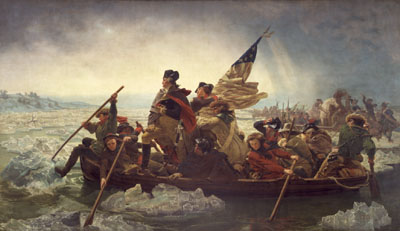 | | |
What if George Washington hadn't crossed the Delaware?
What If... The USA had lost its War of Independence?
During the opening years of the American War of Independence the British Army undoubtedly had the upper hand over the George Washington's forces. Here, we imagine George Washington's defeat in the early stages of the war, e.g.: 1776.
In fact George III and his Cabinet had every reason to believe they were going to win, until their surprise defeats at the Battles of Saratoga and Yorktown. It's only the British Commander, Admiral Howe's characteristic lack of boldness that prevented him from crushing the American forces on at least three occasions.
A number of historians have confirmed this is a strong story which leads to some quite unforseen developments: most astonishingly - there is no French Revolution. How, why?
A large part of Louis XVI's problems were fiscal - bankrupted by his support of the American uprising.
In this programme we have George Washington losing the fight even before France involves itself in the American War of Independence, three thousand miles away across the Atlantic.
Bang goes one of the major causes of the French Revolution - the state's financial crisis in the 1780s, directly attributable to its role in North America.
Our speakers for the programme include:
Paul Shirley, winner of the History Today prize for best undergraduate thesis, on slavery and the War of Independence.
Professor Hamish Scott, University of St Andrews
Dr Sarah Pearsall, University of St Andrews, who's an expert on the family correspondence of the time, and the enormous social consequences, the dislocation that followed the war.
Dr Brendan Simms, University of Cambridge
Professor Tim Blanning, University of Cambridge, on the European consequences had George III defeated Washington's forces.
Suggested reading:
A Struggle for Power
Theodore Draper
Little, Brown and Co, 1996
The American Revolution
Ray Raphael
Profile Books, 2002
Redcoats and Rebels
Christopher Hibbert
Grafton Books, 1990
The Glorious Cause
Robert Middlekauff
OUP, 1982
Next Week:
What If... the Germans had discovered that the Allies had cracked Engima during WWII?
| | |
| | |






 to the 17 April 2003 programme