| | | THE LATEST PROGRAMME | | | |
| | 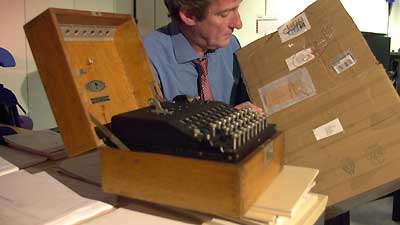 | | |
an Enigma machine
What If... the Germans had discovered that the Allies had cracked Engima during WWII?
It's widely accepted that the intelligence the Allies gained from Enigma shortened the war by several years, and saved the lives of thousands of troops and civilians.
With hindsight it's surprising that the German High Command never realised that their master code had been cracked and was daily being monitored by the Bletchley Park codebreakers - an act that was daily contributing to their demise. Had they appreciated this, how would Hitler have reacted, what evasive action would he have taken, and how might this have affected the outcome of World War Two?
Chris Andrew visits Bletchley Park near Milton Keynes and speaks to several veteran codebreakers, imagining a very different outcome to the Second World War.
Signals intelligence (sigint) from Enigma proved invaluable for Allied victories in a numer of theatres: indeed, without this intelligence it's quite likely that things would have got progressively worse for the Allies.
In 1943 it's quite conceivable that the Allies would have lost the battle of the North Atlantic against the U-boats - the most protracted in naval history. This crucial lifeline across the North Atlantic which enabled the US to shift vast quantities of men and material to Europe (Eastern as well as Western Fronts) would thus have been broken, an enormous loss for the Allies. Consequently the D Day landings wouldn't have been able to go ahead on 6 June 1944 - so, following this argument, Germany couldn't have been defeated by 6 Aug 1945.
Arguably, therefore, the first A bomb would have been used not against Japan at Hiroshima but on mainland Europe, against Germany, and in all probability it would have been used to obliterate Berlin. The USA, after all, was heavily committed to a war policy of 'Germany First', ie: concluding the war in Europe before that in the Pacific and South-East Asia.
Speakers include:
Michael Smith, Defence Correspondent, Daily Telegraph
Christine Large, Director, Bletchley Park Trust
Morag Beattie, former WREN and bombe-operator at Bletchley Park
Mac Hobley, former Telecoms engineer and guide at Bletchley Park
John Harper, electrical engineer reconstructing a bombe at Bletchley Park
Suggested Reading:
Station X: The Codebreakers of Bletchley Park, Michael Smith, Channel 4 Books, 1998
Codebreakers: The Inside Story of Bletchley Park, eds: FH Hinsley and Alan Stripp, OUP, 1993
Enigma: The Battle for the Code, Hugh Sebag-Montefiore, Wedenfeld and Nicholson, 2000
Next Series:
What If... will return next year. If you have any ideas for the programme why not visit our message boards and debate the issues with others?
| | |
| | |






 to the 24 April 2003 programme