Vanessa Collingridge and the team answer listener’s historical queries and celebrate the way in which we all ‘make’ history.
Programme 1
1 April 2008
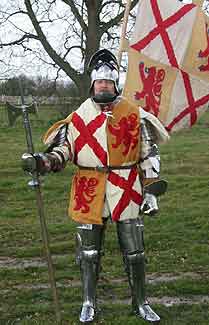
Making History listener Peter Moore is a member of the Worcester Household, a re-enactment group that focuses on events during the War of the Roses. His character is the 1st Earl of Worcester, Sir John Tiptoft. Tiptoft was a Yorkist, Edward IV’s loyal henchman who later earned the title 'butcher of England'. Peter does not deny that Tiptoft was cruel but he points out that he was possibly England's first Renaissance Man, having travelled extensively through Italy. Peter’s question for Making History was: 'how could such a cultured man be such a violent one too?'.
Sir John Tiptoft
Making History listener Peter Moore in costume as Sir John Tiptoft
Vanessa Collingridge spoke to the writer and historian Alison Weir about the life and times of Sir John Tiptoft. He was born 8 May 1427, died 18 October 1470 and according to Alison was an enigmatic, repellent sadist. Descended from an old Norman family, he had an incredible education, which was unusual for a politician at the time. He married well and through one of his three wives he became the Earl of Worcester.
Early career
He enjoyed a brilliant early career. After being created Earl of Worcester on 16 July 1449, he had a number of official posts, first as Lord High Treasurer and then as Lord Deputy of Ireland (1456–1457). After spending two years studying in Italy, he returned to England in 1461 and was received with favour by Edward IV, receiving the Order of the Garter and being appointed to a number of posts. Most notably, as Lord High Constable, he presided over the attainders and executions of Lancastrians, an office which he carried out with exceptional cruelty, having them beheaded, quartered, and impaled. In 1467, he again became Lord Deputy of Ireland, and brought about the execution of the Earl of Desmond and his two infant sons.
Renaissance man
Tiptoft was educated at Oxford University and in 1457 he went on a pilgrimage to Padua and lived in Italy for two years where he studied and became one of England’s foremost Latin scholars – he was a Renaissance man before the Renaissance. In this period only priests had such an education. He was one of the first humanists and translated Cicero. He was friends with Caxton and 'robbed Italy for England'.
Politics
Tiptoft supported Edward IV and crushed the Lancastrians in the Wars of the Roses. In this he was cruel and merciless. He devised his own cruel executions which, in part was a product of his time studying those in power in Italy – a land of warring city states where murderous vendettas, torture and assassinations were commonplace; where cruelty was justified 'for the good of the state'. In this way Tiptoft was very Machiavellian.
Context
The Wars of the Roses lasted 30 years, but in one year of campaigning there might only be 30 days of fighting. So this was not a civil war. It was a fight between royal cousins, and in fact is also known as 'The Cousins' Wars'. Trade and culture still flourished, and the masses didn’t really care whether the Yorks or Lancastrians were in power.
Execution
For his barbarity, the people hated him. In 1470 Henry VI was restored to the throne and Tiptoft was found guilty of treason. He went into hiding in a tree in Huntingdonshire but was captured and sentenced to death – a lenient sentence of death by beheading (not hung drawn and quartered) which reflected his noble status. His execution was scheduled for 17 October 1470 at 3pm, but the crowds were so enormous, all baying for his blood, that he had to be taken back into custody and executed early the following morning. His last act was to ask the executioner to chop off his head with three blows, for the sake of the Trinity.
More than any of his contemporaries he represents the combination of culture and cruelty that was distinctive of the Italians of the Renaissance . Apart from his moral character he was an accomplished scholar, and a great purchaser of books in Italy, many of which he presented to the University of Oxford . He translated Cicero's 'De Amicitia' and Buonaccorso's 'Declaration of Nobleness', which were printed by Caxton in 1481. Caxton in his epilogue eulogised Worcester as superior to all the temporal lords of the kingdom in moral virtue as well as in science.
The Lancaster and York: Wars of the Roses - Alison Weir.
Publisher: Pimlico
ISBN-10: 0712666745
ISBN-13: 978-0712666749
William Walker, the Winchester Diver
Bob Rust of Basildon complained that when Making History visited Winchester in October 2007, we didn’t talk about William Walker the Winchester Diver. Bob heard the story of how Walker worked underneath Winchester Cathedral shoring up the foundations during the war and he asked us to investigate further.
In 1079 the foundations of Winchester Cathedral were placed on a layer of peat on flood meadows. Over the years it turned out that the cathedral’s foundations were flooding and sinking. By the turn of the 20th century the situation had become so severe that the only way to save the cathedral was to remove the complete layer of peat and replace it with concrete.
The space below the cathedral was 3.5 meters high and filled with turbid ground water. A diver had to remove much of the wooden foundation and carry in concrete. That person was William Walker, a diver at the Siebe Gorman company. He thought the job would last a matter of weeks but he was there from 1906 till 1912. Sadly he died during the influenza outbreak at the end of the 1st World War.
There is a statue to Walker at Winchester Cathedral.
Making History would like to thank Winchester Cathedral and the Historical Diving Society for their help.
On Christmas Day 2007, Making History featured Brunel’s South Wales Railway to Fishguard. After the programme we were contacted by David Pearson who lives in Birmingham, who told us about the Duddeston Railway Viaduct which spans nearly three quarters of a mile of the area just to the south of the Bull Ring. Built in the 1840’s by the Great Western Railway it has never been used and David wanted to know why it was built and why has it remained redundant.
According to Dr Peter Leather from the University of Birmingham, prior to 1846 the lines from Birmingham to London Euston, to the south, and Manchester and Liverpool, to the north, were controlled by two separate companies. Although, in theory, collaborators, they were constantly manoeuvring for the upper hand. One piece of subterfuge was an attempt to encourage a rival line from London Paddington via Oxford (a route that was eventually taken over by the GWR) – but this backfired.
The move was a ploy to force a merger which promptly came about. However, the Great Western Railway, which had been drawn in as a bargaining counter, decided to adopt a positive role. It took up the offer (hastily withdrawn, but still on record) and received parliamentary permission for a route from Oxford to Birmingham, a cross-city tunnel, a new station at Snow Hill and a further line to Wolverhampton. The, now, merged company – the London and North Western Railway – strove long and hard to buy off what was essentially its own creation. Anything which hinted at an attempt to gain access to New Street was opposed. But, the original and now bitterly regretted offer had included access to a station at Curzon Street on the LNWR line into New Street.
In order to pursue this link, the GWR built what is known as the Duddeston Viaduct, leaving its main line at Bordesley and heading for Curzon Street. The LNWR held its ground at the property boundary and the link was never completed. The viaduct has never been used but remains to this day.
Vanessa has presented science and current affairs programmes for BBC, ITV, Channel 4, Channel 5 and Discovery and has presented for BBC Radio 4 & Five Live and a regular contributor to the Daily Telegraph and the Mail on Sunday, Scotsman and Sunday Herald.
Contact Making History
Send your comments and questions for future programmes to: Making History BBC Radio 4 PO Box 3096 Brighton BN1 1PL












 Vanessa has presented science and current affairs programmes for BBC, ITV, Channel 4, Channel 5 and Discovery and has presented for BBC Radio 4 & Five Live and a regular contributor to the Daily Telegraph and the Mail on Sunday, Scotsman and Sunday Herald.