Vanessa Collingridge and the team answer listener’s historical queries and celebrate the way in which we all ‘make’ history.
Programme 7
13 November 2007
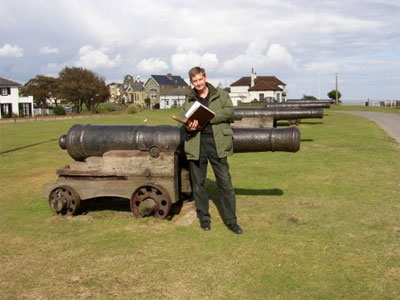
The Guns of Gun Hill
English Civil War specialist John Tincey contacted the programme about a discovery he made in the British Library which finally disproves a local legend in Suffolk. A sign close to six Tudor canon on Gun Hill in Southwold claims that they were a gift to the townspeople from the Duke of Cumberland after his success at the Battle of Culloden in 1746.
However, John came across a booklet which shows that the guns were in place at least a century earlier during the reign of Charles 1st (1625-1649). It shows that ‘culverin’ (‘long guns’) were sent to the towns of Aldeburgh and Southwold to protect the coast from attacks by the pirates of Dunkirk – privateers who enjoyed the support of the Spanish.
During the years when the pirates of Dunkirk harried shipping in the English Channel and attacked the merchant fleets of North Sea ports, the Barbary Corsairs were a threat to vessels from Christian states sailing in the Mediterranean and Atlantic. Indeed the Corsairs attacked villages in the west of England and in southern Ireland.
Professor Nicholas Rodger from the Centre of Maritime Historical Studies at the University of Exeter told Making History that these pirates operated out of ports in North African states from the time of the Crusades right up until the nineteenth century. They understood the value of people and would kidnap merchants and hold them to ransom. Ordinary seamen would be taken and put to work in galleys and other vessels.
By the eighteenth century the British had agreed a truce with the Corsairs and in return for regular payments our merchants were left alone. This was doubly beneficial because shipping from competing nations was still threatened.
Making History listener Pat Blalock has discovered that she is a direct descendant of a watchmaker called Thomas Inskip who lived at Shefford in Bedforshire in the early decades of the nineteenth century. She has discovered that he played a significant role in the careers of two Romantic poets – John Clare and Robert Bloomfield.
Making History consulted Dr Simon Kövesi of Oxford Brookes University
Simon explained that Inskip was not a publisher of volumes of Clare or Bloomfield, Clare was handled by John Taylor (who also published Keats) and Bloomfield by various hands including Capel Loft. However, Inskip was an important correspondent of Clare and a really close friend and helpmeet to Bloomfield. He tried, in vain, to get Clare and Bloomfield to meet up and was a particularly avid correspondent with the steward of Clare's asylum in Northampton. He is buried next to Bloomfield at All saints, Campton in Bedfordshire.
What is the link between the parish of St Pancras, now the home of Eurostar services to Paris and Brussels and the Roman martyr beheaded in 304AD at the age of 14?
Making History consulted Dr John Schofield at the Museum of London.
The legend about this sites links with Roman settlement is described on the Victorian Web
In gardens just behind two great London railway termini (King's Cross and St Pancras) stands a small church with a big history. St Pancras Old Church is truly old. It is reputed to be the oldest church in Britain — maybe even the oldest of all Christian churches. Once pleasantly situated on the banks of the River Fleet and overlooking a Roman encampment, the site is thought to have been used for Christian worship well before the arrival of St Augustine at the end of the sixth century. However, the name of the church (and surrounding parish) may date from that mission. The Roman martyr Pancras was beheaded in 304 AD when he was about 14 years old, and the Basilica of St Pancratius, which preserves the site his martyrdom, is close to where St Augustine lived in Rome: "Hence his devotion to the boy-saint and desire to spread his cult"
Although there may well have been an old settlement on the site of the station, it’s been lost. There are, however, two churches to St Pancras in the parish of St Pancras. The Old St Pancras church is medieval and to the north end of the present railway station and was 'clipped' by the development for it in the 1860’s. Thomas Hardy was employed to oversee the exhumation of human remains to make way for the new station. There is a Roman-style artefact in the church - but there’s little certainty of its provenance.
The other St Pancras church is early nineteenth century and to the south of the parish.
Vanessa has presented science and current affairs programmes for BBC, ITV, Channel 4, Channel 5 and Discovery and has presented for BBC Radio 4 & Five Live and a regular contributor to the Daily Telegraph and the Mail on Sunday, Scotsman and Sunday Herald.
Contact Making History
Send your comments and questions for future programmes to: Making History BBC Radio 4 PO Box 3096 Brighton BN1 1PL












 Vanessa has presented science and current affairs programmes for BBC, ITV, Channel 4, Channel 5 and Discovery and has presented for BBC Radio 4 & Five Live and a regular contributor to the Daily Telegraph and the Mail on Sunday, Scotsman and Sunday Herald.